Platform Event Trap: Meaning, How It Works, and Why It Matters
A simple guide to Platform Event Trap (PET), IPMI hardware alerts, common events, and what administrators should do when they see one

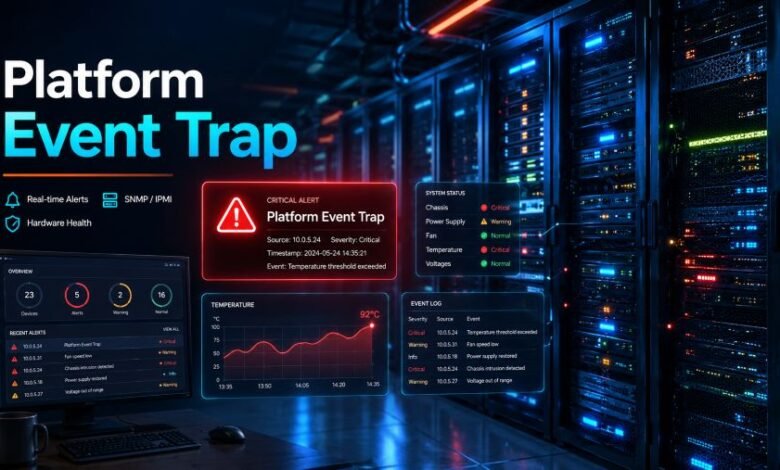
A Platform Event Trap, commonly shortened to PET, is a type of alert used by servers and other managed hardware to report important hardware or firmware events.
It is mainly associated with IPMI (Intelligent Platform Management Interface) and SNMP (Simple Network Management Protocol). A Platform Event Trap can notify a management system when something important happens to the physical machine, such as a temperature problem, power issue, or other hardware-related event.
The important point is that PET monitoring can work independently of the main operating system. This makes it useful for administrators who need to watch the health of servers even when the operating system is unavailable or having problems.
What Is a Platform Event Trap?
A Platform Event Trap (PET) is an IPMI-specific SNMP trap generated when a configured hardware or firmware event occurs.
In simple words, imagine a server automatically sending a warning message to an administrator:
“Something important has happened to my hardware. Please check it.”
That message can be a Platform Event Trap.
Oracle’s server-management documentation describes PET as a configured alert triggered by a hardware or BIOS firmware event. It is transmitted as an SNMP trap and operates independently of the operating system.
This makes PET particularly useful in servers, data centres, enterprise hardware, and remote-management environments.
What Does PET Stand For?
In this context:
PET = Platform Event Trap
It should not be confused with unrelated uses of the letters PET.
When you see PET in IPMI, server-management, BMC, iDRAC, or hardware-monitoring documentation, it generally refers to Platform Event Trap.
Dell, Lenovo, and Oracle documentation all use PET in connection with IPMI hardware management.
How Does a Platform Event Trap Work?
A Platform Event Trap usually follows a simple process.
First, sensors or management hardware monitor the server.
The system may watch things such as:
- Temperature
- Fans
- Power supplies
- Processors
- Hardware presence
- System health
- Firmware-related events
If a configured event occurs, the management controller recognizes it.
It can then generate a Platform Event Trap and send that information to a configured management destination.
The administrator or monitoring software receives the notification and can investigate the event.
Lenovo lists IPMI Platform Event Trap Alerting alongside functions including thermal monitoring, fan control and sensor monitoring in its management-controller documentation.
What Is IPMI?
IPMI, or Intelligent Platform Management Interface, is a technology designed for managing and monitoring computer hardware.
One important advantage is that management functions do not always depend on the operating system.
This means administrators can obtain hardware information and perform certain management tasks even when the main operating system is not functioning normally.
Platform Event Trap is one of the alert mechanisms associated with this type of management environment.
What Is SNMP?
SNMP stands for Simple Network Management Protocol.
It is commonly used to monitor and manage devices over networks.
An SNMP trap is different from repeatedly asking a device whether everything is working. Instead, the device can proactively send a notification when a relevant event occurs.
PET uses this alert concept for platform-management events.
Oracle specifically describes Platform Event Trap as an IPMI-specific SNMP trap.
What Can Trigger a Platform Event Trap?
The exact events depend on the hardware, firmware, management controller, and configuration.
Possible monitored conditions can include hardware-health changes involving components such as temperature sensors, processors, fans or power systems.
For example, Lenovo’s management documentation groups PET alerting with sensor and thermal-monitoring capabilities.
However, receiving a PET message does not automatically mean that the server has suffered a serious failure.
The actual event information and severity should always be checked.
For example, Lenovo documents one message stating that a Platform Event Trap was generated and classifies that particular message as informational, with no action required.
Therefore, users should not assume that every PET notification means critical hardware damage.
Is Platform Event Trap an Error?
Not necessarily.
This is one of the most important things to understand.
A Platform Event Trap is an alert mechanism, not a specific error by itself.
The trap tells a management system that an event occurred. Whether that event is harmless, informational, a warning, or critical depends on the event behind the trap.
For instance, Lenovo’s documented Platform Event Trap message FQXTS2387714 is categorized as informational.
So if you see the words “Platform Event Trap generated”, you should investigate the associated event before concluding that something is broken.
What Should You Do After Receiving a Platform Event Trap?
If a PET appears in your monitoring system, start by reading the complete alert rather than focusing only on the words “Platform Event Trap.”
Check:
- Event description
- Severity level
- Time of the event
- Sensor or component involved
- Server management logs
- System Event Log
- Hardware health information
You should also check the documentation for your specific server or management controller because manufacturers can display events differently.
Dell documentation, for example, includes tools that can decode IPMI events and Platform Event Trap data.
If the message is informational and the manufacturer states that no action is required, there may be nothing to repair.
If the underlying event reports a real hardware problem, follow the manufacturer’s recommended troubleshooting steps.
Platform Event Trap and BMC
You may also encounter Platform Event Trap while working with a BMC, or Baseboard Management Controller.
A BMC is a dedicated management component found in many servers and enterprise devices.
It can monitor hardware status separately from normal operating-system activity.
This is one reason PET alerts are valuable: important platform information can be communicated through management infrastructure rather than depending completely on software running inside Windows, Linux, or another operating system.
Dell documentation shows Platform Event Trap functionality within its server and BMC management ecosystem, while Lenovo also identifies PET alerting as an IPMI management feature.
Platform Event Trap vs Normal Software Alert
A normal software alert often depends on an application or operating system.
A Platform Event Trap is designed for platform-level management.
| Feature | Platform Event Trap | Normal Software Alert |
|---|---|---|
| Main focus | Hardware/platform events | Application or OS events |
| Related technology | IPMI and SNMP | Depends on software |
| OS dependency | Can operate independently | Often requires OS/software |
| Common environment | Servers and managed hardware | Apps and operating systems |
| Main purpose | Hardware event notification | Software/system notification |
The exact implementation varies by manufacturer.
Is Platform Event Trap Still Used?
Yes.
Although the underlying technologies have existed for many years, current enterprise hardware documentation still references Platform Event Trap.
Lenovo documentation continues to include Platform Event Trap messages and IPMI PET functionality, while Dell’s documentation also references PET-related management features and event decoding.
This makes the term particularly relevant to server administrators, data-centre technicians and people troubleshooting enterprise hardware.
Platform Event Trap and CI/CD: Are They the Same Thing?
There is an important distinction.
Some newer online articles use the phrase “platform event trap” more broadly for automated controls that react to events inside software-development or CI/CD workflows.
For example, Xygeni uses the phrase for security controls reacting to events such as commits, dependency updates and configuration changes.
However, the established technical meaning documented by major server vendors is Platform Event Trap (PET) in IPMI, where it refers to an SNMP-based platform-management alert.
Readers should therefore check the context.
If the term appears beside IPMI, BMC, SNMP, server hardware or firmware, it almost certainly refers to the hardware-management meaning.
If it appears in an article about DevOps or CI/CD security, the author may be using the phrase in a broader or different way.
Frequently Asked Questions
What is a Platform Event Trap?
A Platform Event Trap is an IPMI-related SNMP notification used to report configured hardware or firmware events.
What does PET mean in server management?
PET stands for Platform Event Trap.
Is Platform Event Trap a virus?
No. Platform Event Trap is a legitimate term used in server and hardware management.
Does a PET mean my server is failing?
Not always. PET is an alert mechanism. Some PET-related messages can be informational rather than critical.
Is Platform Event Trap related to IPMI?
Yes. Oracle describes PET as an IPMI-specific SNMP trap.
Can PET work without the operating system?
Platform Event Trap is designed as an out-of-band management mechanism and can operate independently of the operating system.
Where can I find Platform Event Trap settings?
The location depends on your hardware and management system. Settings may appear in a BMC, server-management interface, IPMI configuration or remote-management controller.
Should I disable Platform Event Trap?
Not simply because you see the term. PET can provide useful hardware alerts. Instead, check what events are configured, where alerts are sent and whether unwanted notifications are caused by incorrect settings.
Final Thoughts
Platform Event Trap (PET) is mainly a server and hardware-management alert mechanism associated with IPMI and SNMP.
It allows hardware or firmware events to generate notifications that can be sent to a management system without relying entirely on the server’s main operating system.
Most importantly, a Platform Event Trap is not automatically an error or hardware failure. It tells you that an event has been generated. The severity and underlying event determine whether action is actually required.
For anyone managing servers, enterprise hardware or BMC systems, understanding PET can make hardware alerts easier to identify, interpret and troubleshoot.