Fintech App Development: Complete Guide for 2026
How modern financial apps are planned, built, secured, tested, and prepared for real users.

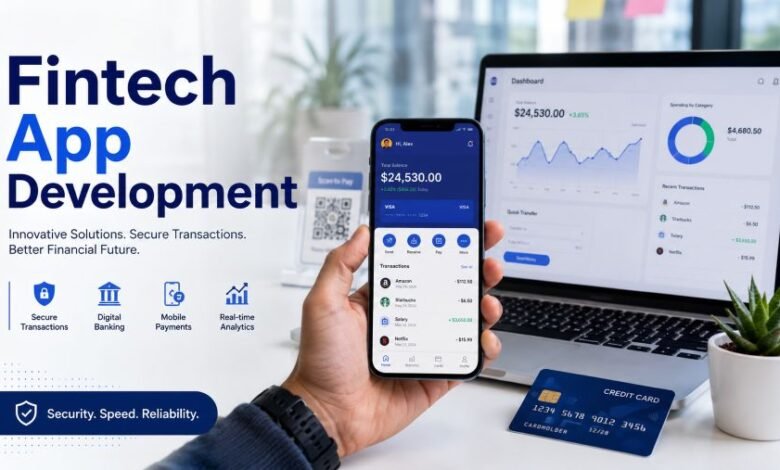
Introduction
Money is becoming more digital every year. People now use mobile apps to send payments, check bank balances, invest money, manage budgets, apply for credit, receive salaries, and run business finances.
This change has made fintech app development important for banks, startups, payment companies, lenders, investment platforms, and other financial businesses.
But building a financial application is different from creating a normal mobile app. A fintech product may handle money, personal information, payment details, identity documents, transaction records, and other sensitive data. Security, privacy, reliability, and regulatory requirements therefore need to be considered from the beginning.
Modern security guidance supports this secure-by-design approach. NIST recommends adding secure software development practices throughout the software development lifecycle, while OWASP provides dedicated security standards and testing guidance for mobile applications.
This guide explains how fintech applications work, the features they may need, the development process, security requirements, technology choices, costs, trends, and common mistakes.
Quick Facts
| Topic | Quick Information |
|---|---|
| Main purpose | Deliver financial services through digital applications |
| Common platforms | Android, iOS, web, and cross-platform apps |
| Popular products | Banking, payments, lending, investing, budgeting and insurance |
| Important requirement | Strong security |
| Authentication | Passwords, MFA, biometrics and passkeys |
| Payment security | PCI DSS may apply when payment-card data is handled |
| Mobile security | OWASP MASVS can be used as a security baseline |
| Secure development | NIST SSDF provides secure software development practices |
| API security | OAuth-based financial-grade APIs may be used |
| Important integrations | Banks, payment gateways, KYC providers and financial APIs |
| Main data | User identity, transactions, accounts and financial information |
| Testing | Functional, security, performance and usability testing |
| Development model | Native, cross-platform or web |
| Cloud usage | Common for scalable backend infrastructure |
| AI usage | Fraud detection, support, analysis and personalization |
| Open finance | Expanding access to financial data and services |
| Main challenge | Balancing convenience with security and compliance |
| Development cost | Depends strongly on features and regulatory requirements |
| Development time | Depends on product size, integrations and testing |
| Post-launch work | Monitoring, updates, security fixes and feature improvements |
What Is Fintech App Development?
Fintech stands for financial technology.
Fintech app development is the process of designing and building software that provides financial services digitally.
A financial application might allow a user to:
- send or receive money,
- manage a bank account,
- track spending,
- pay bills,
- invest in financial products,
- request a loan,
- exchange currencies,
- manage business expenses,
- buy insurance,
- or connect accounts from different financial providers.
Some fintech products serve individual consumers, while others are designed for businesses, banks, merchants, accountants, investors, or financial institutions.
The exact structure depends on what financial problem the application is trying to solve.
Popular Types of Fintech Apps
Digital Banking Apps
Digital banking applications allow customers to perform common banking activities without visiting a branch.
Features can include account balances, transfers, statements, payment cards, bill payments, savings tools, and account notifications.
Payment Apps
Payment applications help users move money between people or businesses.
They may support:
- person-to-person transfers,
- merchant payments,
- QR payments,
- online checkout,
- international transactions,
- recurring payments,
- and digital wallets.
Personal Finance Apps
Budgeting and money-management applications help users understand where their money goes.
Typical features include expense categories, spending reports, savings goals, subscriptions, alerts, and account aggregation.
Investment Apps
Investment platforms allow users to monitor or access financial products from their phones.
Depending on the service and jurisdiction, these may cover stocks, funds, bonds, portfolios, retirement products, or other investments.
Lending Apps
Digital lending platforms can help users request credit, upload information, complete identity checks, review loan terms, and make repayments.
Because lending is regulated differently around the world, legal and compliance requirements should be checked for every target market.
Insurance Technology Apps
Insurtech products may help customers compare policies, purchase coverage, submit claims, manage documents, or communicate with insurers.
Business Finance Platforms
Fintech is also widely used by companies.
Business-focused products can offer invoicing, payroll, expense management, accounting integrations, payment collection, corporate cards, and cash-flow tools.
Essential Features of a Fintech Application
Not every financial app needs the same functionality. However, several features are common.
Secure User Registration
The signup process should be simple while collecting the information required for the service.
Some products may also need identity verification or Know Your Customer checks.
Strong Authentication
Financial accounts are attractive targets for attackers, so authentication deserves special attention.
Multi-factor authentication, biometric authentication, device verification, and passkeys can reduce dependence on traditional passwords.
Apple and Google both describe passkeys as a safer and easier alternative to passwords. Passkeys can use device-based authentication such as a fingerprint, face recognition, PIN, or similar mechanism.
Personal Dashboard
A clear dashboard should show the information users need most.
This might include:
- current balance,
- recent transactions,
- spending,
- investments,
- upcoming payments,
- savings,
- or account activity.
Too much information on one screen can make a financial product confusing.
Real-Time Notifications
Notifications may inform users about payments, transfers, suspicious activity, bill deadlines, deposits, login attempts, or account changes.
They also give customers greater visibility into what is happening with their money.
Transaction History
Users should be able to review financial activity clearly.
Useful tools may include search, filters, categories, dates, transaction details, and downloadable statements.
Customer Support
Support can be delivered through live chat, secure messaging, help centres, automated assistants, phone support, or combinations of these options.
For financial products, support should be easy to reach when something goes wrong.
How Fintech App Development Works
A strong financial product normally starts before any code is written.
1. Identify the Problem
The first question is simple:
What financial problem will the app solve?
Trying to build every possible feature normally creates unnecessary complexity.
A better starting point is one clear need, such as easier international transfers, better expense tracking, faster merchant payments, or simpler business invoicing.
2. Research the Target Users
Developers and product teams should understand who will use the service.
Important questions include:
- Who are the customers?
- What financial problems do they have?
- Which devices do they use?
- What makes them trust a financial service?
- Which existing solutions do they use?
- Why would they switch?
These answers influence design and product priorities.
3. Check Regulatory Requirements
This stage should happen early rather than immediately before launch.
Rules can depend on:
- country,
- type of financial service,
- payment methods,
- customer location,
- data being processed,
- lending activity,
- investments,
- banking relationships,
- and digital assets.
For example, the UK continues to develop its open-banking and open-finance framework. The FCA reported more than 16 million active UK open-banking users by the end of 2025 and a 53% increase in open-banking payments during 2025.
Requirements should therefore be evaluated for the exact market where the product will operate.
4. Design the User Experience
Financial interfaces should make complicated information easier to understand.
Users should immediately know:
- where their money is,
- what action they are taking,
- how much it will cost,
- who will receive the money,
- and whether the action was completed.
Important transactions may also require confirmation screens to reduce accidental actions.
5. Build the Backend
The backend manages much of the important work behind the interface.
It may handle:
- accounts,
- transactions,
- authentication,
- databases,
- notifications,
- integrations,
- reporting,
- fraud controls,
- and business logic.
Backend reliability becomes especially important when real money is involved.
6. Connect Financial APIs
Modern fintech platforms often communicate with outside services through APIs.
These may include banking platforms, payment processors, identity services, card systems, currency services, accounting platforms, or open-banking providers.
For high-value API environments, the OpenID Foundation finalized the FAPI 2.0 Security Profile in February 2025. It provides an OAuth-based security profile designed for high-security API applications.
7. Test Everything
Testing should cover more than whether buttons work.
A financial app may need:
- functional testing,
- API testing,
- security testing,
- device testing,
- performance testing,
- accessibility testing,
- usability testing,
- and transaction testing.
Different network conditions and unusual user actions should also be considered.
8. Launch and Monitor
Development does not finish when an application reaches the app store.
Teams still need to monitor:
- failures,
- suspicious activity,
- crashes,
- security issues,
- performance,
- user feedback,
- and transaction errors.
Updates should continue as technology, user expectations, threats, and regulatory requirements change.
Security in Fintech App Development
Security is one of the most important parts of any financial product.
OWASP describes its Mobile Application Security Verification Standard, or MASVS, as an industry standard for mobile app security and a baseline that developers and security testers can use when assessing applications.
Important security areas include authentication, secure storage, cryptography, network communication, platform interaction, code quality, privacy, and resistance to attacks.
Protect Sensitive Data
Sensitive information should be protected both when stored and when transferred.
Developers should also avoid collecting unnecessary data.
The less sensitive information a company stores, the less information it has to protect.
Secure the Development Process
Security should not be added only after development.
NIST’s Secure Software Development Framework recommends integrating security practices into normal software development processes. NIST also published updated DevSecOps implementation guidance in March 2026.
This can include secure coding, dependency management, vulnerability testing, code review, access controls, and controlled software releases.
Payment Card Security
Applications that store, process, or transmit payment-card information may need to follow PCI DSS requirements depending on their role and environment.
PCI DSS v4.0.1 is the current limited revision of the standard, and the previously future-dated PCI DSS v4.x requirements became effective on March 31, 2025.
Payment architecture should therefore be designed carefully instead of treating card security as a last-minute task.
Fintech App Technology Stack
There is no single technology stack that works for every project.
Mobile Development
Common approaches include:
Native apps: Separate applications for Android and iOS.
Cross-platform apps: A shared codebase can be used across multiple mobile platforms.
The decision should consider performance, security requirements, development resources, product complexity, and long-term maintenance.
Backend Technologies
Backend systems can be built using languages and frameworks suited to secure, scalable applications.
The exact technology matters less than choosing a mature stack that the development team understands and can maintain properly.
Databases
Financial systems may process large amounts of structured information.
Database architecture should support:
- secure access,
- consistency,
- backups,
- recovery,
- auditing,
- and scaling.
Cloud Infrastructure
Cloud services can help fintech companies scale computing resources and deploy services across different regions.
However, using cloud infrastructure does not automatically make a product secure. Access controls, configuration, encryption, monitoring, and backup policies still need careful management.
How Much Does a Fintech App Cost?
There is no useful single price for all fintech products.
A budgeting application and a complete digital banking platform may have completely different requirements.
Development cost usually depends on factors such as:
- number of features,
- Android and iOS support,
- custom UI design,
- backend complexity,
- payment integration,
- bank connectivity,
- identity verification,
- compliance requirements,
- security testing,
- analytics,
- administration tools,
- cloud infrastructure,
- and ongoing maintenance.
A smaller minimum viable product normally requires fewer resources than a multi-market platform handling several regulated financial services.
Businesses should therefore calculate cost from a defined feature list instead of starting with a general industry price.
What Affects the Development Timeline?
The same rule applies to development time.
A simple financial tool can be delivered much faster than a product requiring banking integrations, identity verification, payment processing, multiple user roles, complex reporting, and regulatory approval.
The schedule may depend on:
- product research,
- UX design,
- application architecture,
- API availability,
- third-party approvals,
- compliance work,
- development,
- testing,
- security review,
- and app-store preparation.
Building quickly should never mean skipping important security or financial controls.
Fintech Trends to Watch in 2026
Artificial Intelligence
AI is becoming more important in financial services.
Potential applications include customer support, fraud analysis, document processing, risk monitoring, financial insights, and personalised experiences.
In July 2026, the UK’s Financial Conduct Authority published the Mills Review examining how AI may reshape retail financial services through 2030 and beyond. The regulator has also been running AI testing and sandbox initiatives for fintech firms.
AI features still require strong oversight because financial decisions can have serious effects on customers.
Open Banking and Open Finance
Open banking lets approved services connect with financial account information or payment capabilities through secure interfaces where the relevant framework allows it.
The next stage is broader open finance, which may extend this model to more financial products and datasets.
The FCA announced an open-finance programme in April 2026 that includes work around areas such as SME credit and mortgages.
Passwordless Authentication
Traditional passwords are gradually being complemented or replaced by passkeys.
Both Apple and Google support passkey-based login, making passwordless authentication increasingly practical for mobile and web products.
For financial applications, easier authentication can be valuable when it does not weaken security.
Better Fraud Prevention
Financial applications increasingly need systems that can identify unusual behaviour without making normal customers struggle with every transaction.
The strongest approach combines technology with clear rules, monitoring, human review where necessary, and secure account recovery.
Common Fintech Development Mistakes
Building Too Many Features
A first version does not need to solve every financial problem.
Start with the main customer need.
Treating Security as a Final Step
Security problems become harder and more expensive to fix when discovered very late.
Security requirements should influence architecture from the beginning.
Complicated User Experience
Financial products already involve numbers, rules, and unfamiliar terms.
The interface should reduce this complexity rather than add to it.
Ignoring Compliance Until Launch
A completed application can still face major problems if its business model does not meet local financial requirements.
Regulatory research should happen during early planning.
Depending Too Heavily on One Provider
Fintech products often depend on third-party payment, banking, identity, cloud, or messaging services.
Teams should understand what happens when one of these services becomes slow or temporarily unavailable.
How to Choose a Fintech App Development Company
Before hiring a development partner, ask about more than design.
A capable team should be able to explain:
- how financial data will be protected,
- how authentication will work,
- how APIs will be secured,
- how application testing will be performed,
- how infrastructure will scale,
- how incidents will be monitored,
- and how future updates will be managed.
Experience with secure software development is more valuable than a portfolio containing attractive screens alone.
Frequently Asked Questions
What is fintech app development?
It is the process of creating digital applications that provide or support financial services such as payments, banking, lending, investing, budgeting, and business finance.
Is it difficult to build a fintech app?
It can be more complicated than ordinary application development because financial products often involve sensitive data, security controls, external financial services, and regulatory requirements.
What features should a fintech app have?
The answer depends on its purpose. Common features include registration, authentication, dashboards, transactions, payment functions, notifications, customer support, account management, and security controls.
Can AI be added to a fintech app?
Yes. AI can support areas such as customer service, fraud analysis, financial insights, document processing, and personalization. Financial businesses should still consider governance, accuracy, security, privacy, and human oversight.
Are fintech apps safe?
They can be built securely, but safety depends on how the product is designed, developed, tested, monitored, and maintained. Established guidance such as OWASP MASVS and NIST SSDF can help development teams build stronger security processes.
Do fintech apps need PCI DSS?
PCI DSS may apply when an organisation stores, processes, or transmits payment-card account data or otherwise falls within the standard’s scope. The exact responsibilities depend on the payment architecture and business role.
What is the best technology for a fintech app?
There is no universal best technology. The correct stack depends on security needs, functionality, expected traffic, integrations, development skills, budget, and long-term maintenance.
Conclusion
Successful fintech products combine useful financial services with simplicity, security, reliability, and trust.
The strongest fintech app development strategy starts with one clear customer problem. The team can then define the required features, understand the regulatory environment, design a simple interface, build secure infrastructure, connect the necessary financial services, and test the product carefully.
New technologies such as AI, open finance, financial-grade APIs, and passwordless authentication are creating new possibilities. However, the basic goal remains the same: help users manage financial tasks safely and easily.
A fintech app should not simply look modern. It should make financial activity clearer, safer, and more convenient for the people using it.