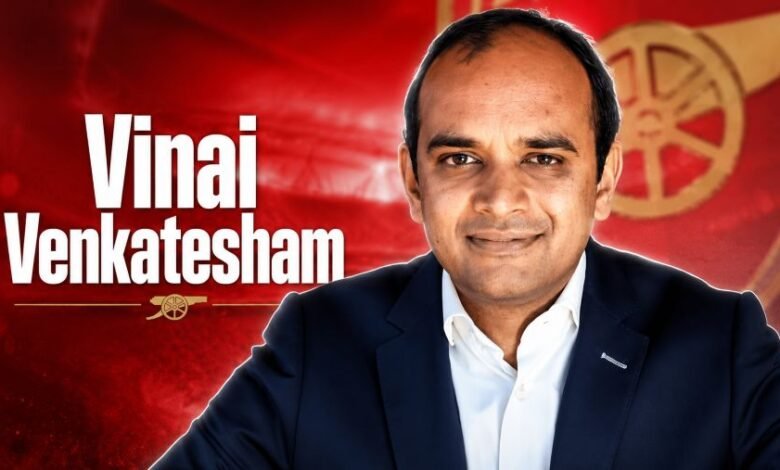
Vinai Venkatesham: Tottenham CEO and Football Executive
From the London 2012 Olympics to senior leadership at two major Premier League clubs

Introduction
Vinai Venkatesham is a British football executive who serves as the Chief Executive Officer of Tottenham Hotspur. He officially started the role on 1 June 2025 and is responsible for both sporting and non-sporting operations at the club.
Before joining Tottenham, he spent 14 years at Arsenal. He joined the club’s commercial department in 2010 and later became Chief Commercial Officer, Managing Director and Chief Executive Officer.
His career is unusual because he did not begin as a football player, coach or agent. Instead, he developed experience in accounting, consulting, business strategy, sponsorship and sports administration before reaching the highest level of football leadership.
Quick Facts
| Field | Information |
|---|---|
| Full name | Vinaichandra Guduguntla Venkatesham |
| Professional name | Vinai Venkatesham |
| Born | April 1981 |
| Age | 45 years old as of July 2026 |
| Nationality | British |
| Profession | Football executive and sports administrator |
| Current role | Chief Executive Officer of Tottenham Hotspur |
| Previous major role | Chief Executive Officer of Arsenal |
| Honour | Officer of the Order of the British Empire |
| Known for | Senior leadership at Arsenal and Tottenham Hotspur |
His official company records list him as a British national living in England. These records also confirm his active directorships connected with Tottenham Hotspur.
Who Is Vinai Venkatesham?
Vinai Venkatesham is one of the most recognised business leaders working in English football.
He became widely known during his years at Arsenal, where he moved through several important commercial and leadership positions. He later crossed north London to become the CEO of Tottenham Hotspur.
A football chief executive does not select the starting team or coach players. The role involves leading the wider organisation, supporting football operations, managing business departments and helping the club create a clear long-term plan.
Venkatesham’s position places him between sporting performance and corporate management. He must work with owners, directors, coaches, recruitment teams, commercial partners, employees and supporters.
Early Life and Education
Venkatesham grew up in London and later studied Economics and Management at the University of Oxford.
His education gave him knowledge of finance, markets, organisations and business decision-making. These subjects became useful when he moved into consulting and sports administration.
He also qualified as a management accountant. This professional training helped him understand financial planning, performance measurement and the careful use of organisational resources.
Unlike many people working at major football clubs, Venkatesham did not enter the industry through a playing career. His route began through education, finance and business strategy.
Early Professional Career
Before working in football, Venkatesham gained experience in several different industries.
He briefly worked in commodities trading before joining Deloitte as a strategy consultant. At Deloitte, he worked with businesses facing questions about growth, competition, organisation and long-term planning.
Consulting taught him how to study difficult problems, examine evidence and present possible solutions. These skills later became important when he started managing large sports organisations.
His career changed direction when he joined the commercial team responsible for the London 2012 Olympic and Paralympic Games.
Work on the London 2012 Games
The London 2012 project gave Venkatesham his first major opportunity in the sports industry.
He worked on commercial areas such as sponsorship, broadcasting, hospitality, licensing and merchandising. These activities helped generate the income and business partnerships required to organise one of the world’s largest sporting events.
The role allowed him to work with international brands and understand how sport connects with media, supporters, advertisers and commercial partners.
It also helped him move from traditional business consulting into long-term sports administration.
His experience shows that working in sport requires more than knowledge of matches and players. Major events and football clubs also need people who understand finance, marketing, communication and business development.
Joining Arsenal
Venkatesham joined Arsenal in 2010 as Head of Global Partnerships.
His early responsibility was to help the club develop relationships with commercial partners around the world. These partnerships included sponsorship agreements and other projects that supported Arsenal’s international growth.
He later became Sales and Marketing Director before being promoted to Chief Commercial Officer in 2014.
As Chief Commercial Officer, he worked across sponsorship, marketing, hospitality, retail, media and customer relationships. His responsibilities grew as football clubs became larger international businesses.
This period also gave him a detailed understanding of Premier League football, including the connection between sporting results, supporter loyalty and commercial growth.
Becoming Arsenal Managing Director
Arsenal changed its senior leadership structure in 2018 after Chief Executive Ivan Gazidis left the club.
Venkatesham was promoted to Managing Director, while football executive Raúl Sanllehí became Head of Football.
The new structure divided responsibility between business management and football operations. Venkatesham focused mainly on the organisation’s commercial and administrative work.
This was an important promotion because it placed him close to the club’s ownership and board. He became involved in major decisions affecting Arsenal’s strategy, staff and future direction.
Arsenal Chief Executive Officer
Venkatesham became Arsenal’s Chief Executive Officer in 2020.
The position gave him responsibility across the whole club, including both sporting and non-sporting areas. He worked closely with the ownership, senior football staff and commercial departments.
His early period as CEO included the difficult effects of the COVID-19 pandemic. Football clubs played matches without normal crowds, while matchday income and everyday operations faced major disruption.
Arsenal later returned to the UEFA Champions League and became more competitive near the top of the Premier League.
Venkatesham also supported closer communication between the club and its supporters. Arsenal created more structured discussions with fan groups and increased attention on supporter involvement.
His long journey from partnerships executive to CEO demonstrates the same strategic skills required in global executive leadership, where decisions must balance employees, customers, finances and long-term organisational goals.
Contribution to Women’s Football
Venkatesham has also played an important role in the development of professional women’s football in England.
While at Arsenal, he supported greater investment in the women’s team, including improved facilities, staffing and opportunities to play matches at Emirates Stadium.
He later chaired a working group created to examine the future structure of England’s top professional women’s leagues.
The group helped develop plans for a more independent organisation responsible for the Women’s Super League and Women’s Championship.
This work became one of the most important parts of his wider contribution to English football.
Leaving Arsenal
In September 2023, Arsenal announced that Venkatesham had decided to leave the club during the following summer.
He completed his Arsenal career in 2024 after approximately 14 years with the organisation.
During that period, he had progressed through several roles:
- Head of Global Partnerships
- Sales and Marketing Director
- Chief Commercial Officer
- Managing Director
- Chief Executive Officer
The length of his service gave him experience across nearly every major business area of a modern football club.
Joining Tottenham Hotspur
Tottenham Hotspur announced Venkatesham’s appointment as its new CEO on 11 April 2025.
He officially began working at the club on 1 June 2025. According to the official Tottenham Hotspur announcement, his responsibilities cover both sporting and non-sporting matters.
The appointment attracted strong attention because Tottenham and Arsenal are historic north London rivals.
However, major football clubs usually appoint senior executives because of their professional experience rather than their personal connection with a team.
Venkatesham brought knowledge of the Premier League, commercial partnerships, supporter relations, governance and football operations.
Current Responsibilities at Tottenham
As Tottenham CEO, Venkatesham helps lead the club’s overall strategy and everyday organisation.
His responsibilities include supporting the men’s and women’s football teams, improving organisational performance, managing commercial operations and communicating with supporters.
He has publicly said that Tottenham wants its men’s team to compete regularly for major trophies and Champions League qualification. He has also discussed the need to improve the women’s team and create a stronger football structure.
Following a difficult 2025–26 season, Venkatesham said that Tottenham required a complete reset in parts of its football operation.
He explained that the club had strong commercial foundations, a modern stadium and excellent training facilities. However, he also recognised that sporting processes and performance standards needed significant improvement.
Leadership Style
Venkatesham’s public communication usually focuses on teamwork, responsibility and long-term planning.
He rarely presents success as the work of one person. Instead, he speaks about the combined contribution of employees across football, finance, marketing, media, technology and stadium operations.
His consulting and accounting background may explain his structured approach. He appears to value evidence, organisation and clear responsibilities.
He has also spoken about the importance of listening to supporters. Football fans are not ordinary customers because their connection with a club may continue throughout their lives.
Successful football leadership must therefore consider results, history, identity and community alongside income and business growth.
OBE and Other Recognition
Venkatesham was appointed an Officer of the Order of the British Empire in the 2024 New Year Honours.
The honour recognised his services to sport, including his contribution to football and the development of the women’s game.
He was also named GG2 Man of the Year in 2023. The recognition highlighted his position as an influential British Asian leader working at the highest level of English football.
These honours reflect work that extends beyond one club. His career has included football governance, Olympic administration and support for the growth of women’s sport.
Football Governance and Board Roles
Venkatesham has held several responsibilities outside Arsenal and Tottenham.
He has served as a non-executive director of the British Olympic Association. He has also held positions connected with the European Club Association, Wembley Stadium and international club competitions.
These appointments show that his experience is valued beyond everyday club management.
Football governance involves rules, competitions, commercial agreements and relationships between clubs, leagues and governing organisations.
His background in consulting and sports business made him suitable for these wider responsibilities.
Mental-Health Support Through Football
Venkatesham helped support the development of a Premier League suicide-prevention project involving clubs, mental-health professionals and broadcaster Roman Kemp.
The programme was designed to help football supporters find safe spaces, information and professional support.
Football clubs have large and loyal communities. This gives them an opportunity to reach people who may not normally ask for help.
The project shows how football organisations can use their influence for purposes beyond matches and commercial activity.
Public Image
Venkatesham maintains a relatively private and professional public image.
Most of his interviews focus on football leadership, club strategy, supporter communication and organisational development.
He is not known for sharing luxury purchases or private lifestyle details. His public identity is closely connected with his professional responsibilities.
His move from Arsenal to Tottenham created debate among supporters because of the rivalry between the clubs. However, his position is based on executive leadership rather than playing loyalty.
Why Is Vinai Venkatesham Important?
Venkatesham is important because his career explains how modern football clubs operate away from the pitch.
Players and coaches receive most of the public attention, but clubs also require experienced executives to manage money, staff, partnerships, facilities and long-term plans.
His path from Deloitte and the London Olympics to Arsenal and Tottenham shows that many different professional skills are needed in football.
He has also contributed to women’s football, sports governance and mental-health initiatives.
Interesting Facts
- He studied Economics and Management at Oxford.
- He qualified as a management accountant.
- He worked as a strategy consultant at Deloitte.
- He helped organise the London 2012 Olympic and Paralympic Games.
- He joined Arsenal in 2010.
- He spent approximately 14 years at Arsenal.
- He became Arsenal CEO in 2020.
- He received an OBE for services to sport.
- He joined Tottenham as CEO in June 2025.
- His career covers football, Olympic sport and business leadership.
Conclusion
Vinai Venkatesham has built one of the most notable executive careers in English football.
He began outside the sport, developing skills in finance, consulting and business strategy. His work on the London 2012 Games opened the door to sports administration, while his long Arsenal career helped him understand every level of football-club management.
He now leads Tottenham Hotspur during an important period of sporting and organisational change.
His future reputation will be shaped by Tottenham’s progress, but his career already shows how commercial knowledge, careful planning and strong leadership can create opportunities at the highest level of professional sport.
Frequently Asked Questions
Who is Vinai Venkatesham?
Vinai Venkatesham is a British football executive and the Chief Executive Officer of Tottenham Hotspur.
What is his current role?
He has served as Tottenham Hotspur CEO since 1 June 2025.
Did he work for Arsenal?
Yes. He worked at Arsenal from 2010 until 2024 and later became the club’s CEO.
What did he do before football?
He worked in commodities trading, management consulting and the commercial team for the London 2012 Olympic and Paralympic Games.
Where did he study?
He studied Economics and Management at the University of Oxford.
Why did he receive an OBE?
He received an OBE for services to sport, including his contribution to football and the women’s game.
Is he a former football player?
No. His professional background is in business strategy, finance, commercial operations and sports administration.
When did he join Tottenham?
He officially joined Tottenham Hotspur as CEO on 1 June 2025.