Richard J. Foster Biography: Inspiring Faith and Books
The life, ministry, education, family and lasting influence of the author who transformed modern Christian spiritual formation

introdution
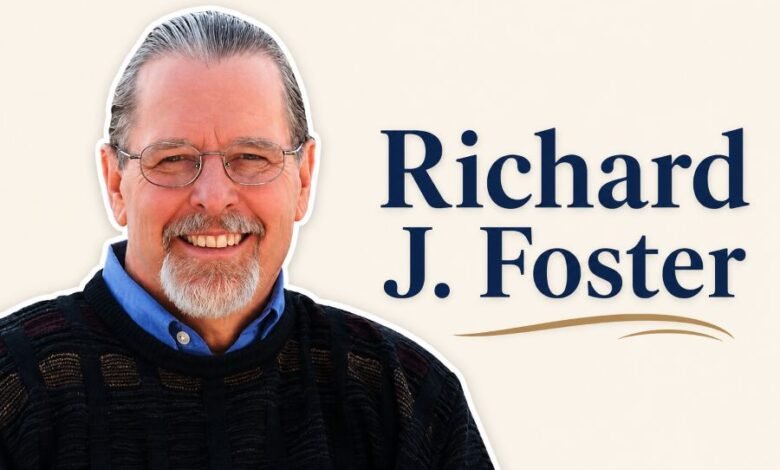
Richard J. Foster is an American Quaker theologian, Christian author, former pastor and teacher. He became internationally known through Celebration of Discipline, one of the most influential modern books about prayer and spiritual growth.
His life story connects ministry, academic study, writing and church renewal. This biography explores his early life, education, wife, children, major books, beliefs and continuing influence.
Richard J. Foster is best known as the author of Celebration of Discipline and the founder of Renovaré.
Quick Bio
| Field | Details |
|---|---|
| Full name | Richard James Foster |
| Professional name | Richard J. Foster |
| Date of birth | 3 May 1942 |
| Age | 84 years old as of 2026 |
| Birthplace | Albuquerque, New Mexico, United States |
| Nationality | American |
| Religion | Christianity |
| Christian tradition | Quaker, Religious Society of Friends |
| Profession | Theologian, author, pastor and teacher |
| Famous for | Celebration of Discipline |
| Education | George Fox College and Fuller Theological Seminary |
| Wife | Alice Carolynn “Carolynn” Foster |
| Children | Joel Timothy Foster and Nathan Lee Foster |
| Major organisation | Renovaré |
| Current status | Retired from regular public speaking and serving as a Renovaré adviser |
Why Is Richard J. Foster Famous?
Richard J. Foster is famous for making historic Christian spiritual practices easier for modern readers to understand.
His breakthrough book, Celebration of Discipline: The Path to Spiritual Growth, explains practices such as prayer, fasting, meditation, simplicity, service and worship.
The book helped introduce spiritual formation to a much wider Protestant and evangelical audience. It has sold more than two million copies and has been translated into many languages.
Foster also founded Renovaré, a Christian organisation devoted to personal spiritual renewal and deeper life with God.
Early Life and Family Background
Richard James Foster was born on 3 May 1942 in Albuquerque, New Mexico.
His parents were Lee Sherman Foster and Marie Temperance Foster. His childhood included periods in several American states, including New Mexico, Mississippi, Nebraska, Wyoming, Colorado and California.
He spent much of his formative life in Southern California. During his teenage years, he became connected with a community of young Quakers.
That religious community played an important role in his Christian conversion and understanding of faith.
Both of Foster’s parents died while he was still a teenager. Members of his church community supported him and helped make his higher education possible.
These early experiences shaped his belief that spiritual growth happens through personal faith, loving relationships and supportive Christian community.
Education and Theological Training
Foster attended George Fox College, now called George Fox University.
He earned a Bachelor of Arts degree in Religion and Philosophy in 1964. His studies gave him a foundation in Christian theology, philosophy, Scripture and Quaker teaching.
He later studied at Fuller Theological Seminary and completed a Doctor of Pastoral Theology degree in 1970.
His doctoral work focused on New Testament studies and social ethics. His dissertation examined Quaker involvement in race relations.
Foster’s education combined academic theology with practical ministry. This balance later became an important feature of his books.
Marriage, Wife and Children
Richard Foster married Alice Carolynn Kerr on 18 March 1967.
She is normally known as Carolynn Foster. Biographical records identify her early professional background as speech therapy.
The couple have two sons, Joel Timothy Foster and Nathan Lee Foster.
Nathan Foster later became involved in Christian writing, teaching and Renovaré’s work. Richard and Carolynn also have grandchildren and have built a long family life around faith and ministry.
His official Renovaré profile states that Richard and Carolynn live near Denver, Colorado.
Beginning of His Ministry
Foster began serving in church ministry while completing his undergraduate studies.
He worked as a youth minister at Alamitos Friends Church in California and was ordained as a minister in the Religious Society of Friends in 1967.
He later served at Arcadia Friends Church before becoming pastor of Woodlake Avenue Friends Church in Canoga Park.
The difficulties of pastoral work became an important turning point. Foster realised that activity, church programmes and personal effort were not enough to create lasting inner change.
He began studying historic Christian writers and experimenting with disciplines such as prayer, silence, fasting and meditation.
Foster’s emphasis on inner transformation differs from the direct evangelistic work associated with ministers such as Rico Tice, but both have focused on helping people understand Christian faith.
Dallas Willard and Other Important Influences
One of the most important people in Foster’s intellectual development was philosopher Dallas Willard.
They met through Woodlake Avenue Friends Church, where Willard participated in a Sunday school class. Their friendship developed through conversations about discipleship and spiritual change.
Willard helped Foster understand that Christians could train themselves for a transformed life without believing they were earning God’s grace.
Lutheran pastor Bill Vaswig was another close friend and influence. Their discussions helped Foster connect personal spirituality with church life and Christian community.
Historic writers from Catholic, Protestant, Orthodox and Quaker traditions also influenced his thinking.
The Story Behind Celebration of Discipline
Foster wrote Celebration of Discipline during the 1970s while teaching spiritual practices to students and church members.
Harper & Row published the book in 1978. It initially received limited attention, but recommendations between readers, pastors and Christian organisations gradually increased its audience.
The book presents 12 spiritual disciplines in three groups.
Inward Disciplines
These include meditation, prayer, fasting and study.
They focus on a person’s inner relationship with God and the formation of thought, desire and character.
Outward Disciplines
These include simplicity, solitude, submission and service.
They influence how a Christian manages possessions, relationships, decisions and responsibilities.
Corporate Disciplines
These include confession, worship, guidance and celebration.
They show that spiritual formation is not only private. It also happens through shared worship and Christian community.
Why Celebration of Discipline Became Important
Foster did not present spiritual disciplines as a way to earn salvation.
He described them as practices that place a person in a position where God’s grace can produce change.
This distinction helped the book reach Christians from many denominations. It offered practical guidance without limiting the message to one church tradition.
Celebration of Discipline eventually became a modern Christian classic. Christianity Today included it among the most influential Christian books of the twentieth century.
Its success established Foster as an important voice in Christian spirituality.
Teaching Career and Academic Work
Foster joined the staff of Newberg Friends Church in Oregon during the 1970s.
He also taught at George Fox College, where he introduced students to Christian devotional traditions and spiritual disciplines.
In 1979, he moved with his family to Wichita, Kansas, and became a professor of theology and writer-in-residence at Friends University.
This position gave him more time to teach, travel and write.
His work attracted audiences across denominational boundaries. He spoke to Quakers, evangelicals, mainline Protestants, Catholics and other Christians interested in deeper spiritual life.
Founding Renovaré
After several demanding years of speaking and travelling, Foster withdrew from regular public activity in 1986.
He used this quieter period for prayer, reflection and discernment.
In 1988, he founded Renovaré with support from Dallas Willard, Bill Vaswig, James Bryan Smith and several other Christian leaders.
The organisation’s name comes from a Latin word connected with renewal.
Renovaré was created to help churches and individuals develop a balanced, transforming relationship with Jesus Christ.
Foster served as its president until 2008. He then stepped away from executive leadership but continued as a founder and adviser.
Richard J. Foster’s Beliefs and Spiritual Philosophy
Foster’s theology centres on spiritual formation.
He teaches that Christian spiritual formation is the gradual transformation of a person’s character into greater Christlikeness.
Prayer, study, service, silence and other disciplines are tools within that process. They are not the final purpose of faith.
His central message is that Christians are invited to live an active and continuing life with Jesus.
Foster also teaches that spiritual practices become dangerous when they create pride, control or legalism. In his view, discipline should produce freedom, humility and love rather than rigid behaviour.
The Six Streams of Christian Tradition
In Streams of Living Water, Foster described six important traditions within Christianity.
Contemplative Tradition
This stream focuses on prayer, silence and awareness of God’s presence.
Holiness Tradition
It concentrates on developing virtue, moral strength and Christlike character.
Charismatic Tradition
This stream emphasises the power and gifts of the Holy Spirit.
Social Justice Tradition
It connects faith with compassion, justice and care for people facing suffering or inequality.
Evangelical Tradition
This stream highlights Scripture, the message of Jesus and the importance of sharing faith.
Incarnational Tradition
It teaches that ordinary work, relationships and physical life can become places where people experience God.
Foster believed Christians should learn from all six traditions rather than treating one stream as complete by itself.
Major Books by Richard J. Foster
As an author, Foster has written about prayer, simplicity, humility, Scripture and disciplined Christian living.
| Year | Book |
|---|---|
| 1970 | Quaker Concern in Race Relations: Then and Now |
| 1978 | Celebration of Discipline |
| 1981 | Freedom of Simplicity |
| 1985 | Money, Sex, and Power |
| 1992 | Prayer: Finding the Heart’s True Home |
| 1998 | Streams of Living Water |
| 2001 | Devotional Classics |
| 2005 | The Renovaré Spiritual Formation Bible |
| 2008 | Life with God |
| 2008 | Longing for God |
| 2011 | Sanctuary of the Soul |
| 2022 | Learning Humility |
His InterVarsity Press author page lists works including Learning Humility, Longing for God and Sanctuary of the Soul.
Writing Style
Foster writes in a calm, practical and reflective style.
He uses stories, Christian history and everyday examples to explain theological ideas without making them unnecessarily difficult.
This ability to make specialist knowledge readable can also be seen in writers such as Alexander McCall Smith, although Foster’s main subject is Christian spirituality rather than fiction.
His books combine teaching with practical exercises. Readers are encouraged to practise the ideas rather than simply study them.
Prayer: Finding the Heart’s True Home
Published in 1992, Prayer: Finding the Heart’s True Home became another major work in Foster’s career.
The book explores different forms of prayer, including simple prayer, meditative prayer, intercession, healing prayer and contemplative prayer.
Foster presents prayer as an honest relationship with God rather than a performance requiring perfect words.
The book strengthened his reputation as a leading teacher of Christian devotional life.
Learning Humility
Foster published Learning Humility: A Year of Searching for a Vanishing Virtue in 2022.
The book follows a year-long journey through the subject of humility.
He uses Scripture, personal reflection, Christian writers and cultural observations to examine how humility can shape character.
The book was later recognised as an Outreach magazine Spiritual Growth Resource of the Year.
Public Image and Personality
Foster’s public image is based on calmness, humility and serious spiritual reflection.
He has generally avoided the style of celebrity leadership often seen around popular speakers and authors.
His interviews show a preference for quiet routines, prayer, relationships and local church life.
He frequently warns leaders against measuring success only through size, money, influence or public attention.
His work ethic reflects patience and long-term formation rather than quick results.
Criticism and Theological Debate
Most debate around Richard Foster concerns theology rather than his private conduct.
Some conservative Christian critics have questioned his teachings about meditation, imagination and contemplative prayer.
They argue that certain practices may be misunderstood or used without enough biblical care.
Foster responds by distinguishing Christian meditation from practices designed only to empty the mind. His teaching directs attention towards God, Scripture and the life of Jesus.
He also warns readers not to turn spiritual disciplines into rigid laws.
No reliable evidence links him to a major criminal, financial or personal scandal.
Retirement and Current Status
Foster stepped down as president of Renovaré in 2008.
In 2018, he retired from regular public-speaking ministry after a final major tour.
His retirement did not completely end his public contribution. He has continued to take part in selected interviews, podcasts and discussions.
In 2024, he appeared in a Renovaré conversation about the story and influence of Celebration of Discipline.
A 2025 interview also showed him discussing pastoral leadership, solitude, daily routines and spiritual formation in a distracted age.
As of June 2026, he remains recognised as Renovaré’s founder and adviser. He lives near Denver with his wife, Carolynn.
Legacy and Influence
Richard J. Foster helped bring historic Christian disciplines back into modern Protestant conversation.
He did not create practices such as fasting, solitude, confession or meditation. His achievement was explaining them in language that modern readers could understand and practise.
Like public scholars such as Daisy Dunn, he built influence by making an old and specialised field accessible to ordinary readers.
His books have influenced pastors, students, teachers, church leaders and Christians seeking a deeper devotional life.
George Fox University also established the Richard J. Foster Award in Spiritual Formation to recognise people helping others build a transforming relationship with Jesus.
Interesting Facts About Richard J. Foster
- His full name is Richard James Foster.
- He lost both parents while still a teenager.
- Members of his Quaker community helped support his education.
- His doctoral research examined Quaker work in race relations.
- He was ordained as a Quaker minister in 1967.
- Celebration of Discipline was published in 1978.
- He founded Renovaré in 1988.
- His son Nathan has also worked in Christian spiritual formation.
- His books are read across several Christian denominations.
- He retired from regular public speaking in 2018.
Conclusion
Richard J. Foster is one of the most influential modern writers on Christian spiritual formation.
His journey from a young Quaker student to pastor, professor, bestselling author and Renovaré founder reflects a lifelong interest in inner transformation.
Through Celebration of Discipline, he made historic practices such as prayer, fasting, service and solitude understandable to millions of readers.
His strongest legacy is the belief that spiritual disciplines are not about religious performance. They are ways of becoming more open to grace, love, humility and life with Jesus.
Frequently Asked Questions
Who is Richard J. Foster?
He is an American Quaker theologian, Christian author, former pastor and founder of Renovaré.
How old is Richard J. Foster?
He is 84 years old as of June 2026.
When was Richard J. Foster born?
He was born on 3 May 1942.
Where was Richard J. Foster born?
He was born in Albuquerque, New Mexico, United States.
What is Richard J. Foster famous for?
He is best known for writing Celebration of Discipline and promoting Christian spiritual formation.
Who is Richard J. Foster’s wife?
His wife is Alice Carolynn “Carolynn” Foster.
Does Richard J. Foster have children?
Yes. He has two sons, Joel Timothy Foster and Nathan Lee Foster.
What religion does Richard J. Foster follow?
He is a Christian minister and theologian from the Quaker tradition.
What organisation did Richard J. Foster establish?
He founded Renovaré in 1988.
Is Richard J. Foster still active?
He has retired from regular public speaking but remains connected with Renovaré as its founder and adviser.