Introduction
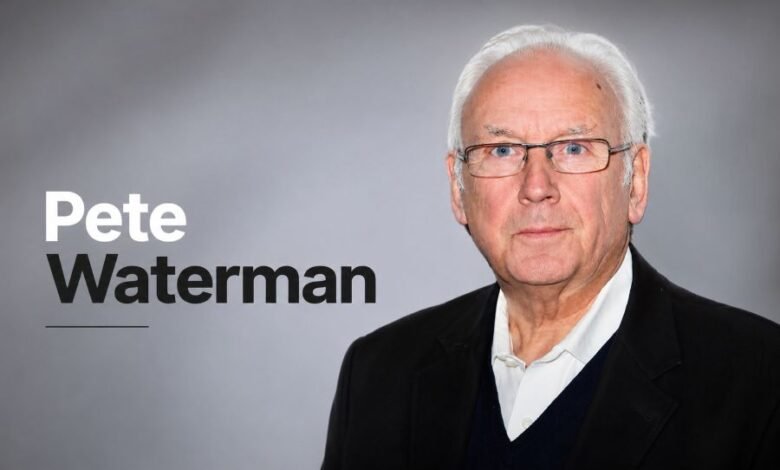
Pete Waterman is usually introduced through a string of enormous 1980s pop hits. That makes sense, but it also hides what makes his career interesting.
As part of Stock Aitken Waterman, he belonged to a team credited by the Official Charts Company with 13 UK No.1 singles and more than 100 Top 40 hits. The partnership helped launch or reshape the careers of Kylie Minogue, Rick Astley, Dead or Alive, Bananarama, Mel & Kim and Jason Donovan.
Yet Waterman’s contribution cannot be understood simply by imagining him sitting behind a mixing desk creating every part of those records. Research into the Hit Factory shows a more specialised operation. Mike Stock and Matt Aitken handled much of the songwriting, arranging, programming and instrumental work. Waterman brought strong A&R instincts, artist selection, commercial judgement, promotional experience and business direction.
That distinction matters. The success of Stock Aitken Waterman came partly from three people performing different jobs unusually well.
Waterman’s other major passion complicates his public image even further. Railways were part of his life before pop stardom, not an expensive hobby acquired after it. He worked on the railway as a young man and later became involved in railway businesses, locomotive preservation, engineering skills, government transport work and charitable projects. As recently as 2026, he remained publicly active through railway exhibitions and his presidency of the Railway Benefit Fund.
Quick Facts
| Fact | Details |
|---|---|
| Full name | Peter Alan Waterman |
| Known as | Pete Waterman |
| Born | 15 January 1947 |
| Birthplace | Coventry, England |
| Known for | Record production, songwriting, music business, television and railway projects |
| Famous production partnership | Stock Aitken Waterman |
| SAW UK No.1 singles | 13, according to Official Charts |
| SAW UK Top 40 hits | More than 100 |
| Major associated artists | Kylie Minogue, Rick Astley, Dead or Alive, Bananarama, Mel & Kim, Jason Donovan |
| Television work | The Hit Man and Her, Pop Idol |
| Railway charity role | President of the Railway Benefit Fund since 2018 |
| Railway heritage organisation | Waterman Railway Heritage Trust, established in 1994 |
| Notable recent achievement | Part of the Railnuts team behind a Guinness-certified 694.9-metre portable model railway in 2024 |
Coventry, the Railway and the Beginnings of a Music Career
Waterman was born in Coventry in 1947 and left school at a young age. One of his earliest jobs was on British Railways, where government biographical material records that he worked around steam locomotives.
This early railway employment is important because it corrects a common assumption about him. Trains were not simply a celebrity collecting interest that developed decades later. The railway was part of his working life before the music industry made him famous.
Music, meanwhile, developed through another practical education.
Waterman became a DJ and spent considerable time watching audiences rather than studying music through a conventional academic route. His official Stock Aitken Waterman biography describes his experience running discos, including events for younger audiences, as formative.
The lesson was straightforward: people revealed what they liked by what made them move.
That experience appears to have shaped one of Waterman’s strongest later abilities — judging songs through their commercial effect on ordinary listeners rather than only through musicianship or critical approval.
Before the Hit Factory, Waterman Learned the Business Side of Pop
Stock Aitken Waterman did not appear from nowhere in the mid-1980s.
By then, Waterman had already accumulated experience as a DJ and in areas including A&R, artist development, promotion and production. Those jobs placed him close to both musicians and the commercial machinery required to turn recordings into hits.
That background helps explain the division of work when he began collaborating with Mike Stock and Matt Aitken in 1984.
The three men had overlapping creative roles, but they were not interchangeable.
Research published in the Journal on the Art of Record Production describes Stock and Aitken as central to the hands-on musical construction of the records. Modern studio technology allowed a relatively small team to write, arrange, programme and build backing tracks rapidly.
Waterman’s strengths were particularly evident elsewhere: identifying artists, judging what might sell, developing concepts, making industry connections and driving the operation commercially.
Reducing him to “the businessman” would be too simplistic. He shared production and songwriting credits and participated in creative decision-making. But portraying all three members as performing identical studio jobs would also distort how the Hit Factory worked.
“You Spin Me Round” Changed the Scale of Everything
The first unmistakable proof that the system could produce a major hit came from Dead or Alive.
“You Spin Me Round (Like a Record)” climbed to No.1 on the UK Singles Chart in March 1985, according to Official Charts. It became the first UK chart-topper associated with the Stock Aitken Waterman partnership.
Its path to No.1 was not instant.
That detail matters because later descriptions of the Hit Factory can make its success sound almost mechanical: write song, release song, collect No.1. In reality, even the breakthrough record took time to establish itself.
Once the formula began connecting with mainstream audiences, however, the scale changed rapidly.
The team became associated with an extraordinary concentration of British pop hits during the second half of the 1980s.
Kylie Minogue Showed How Powerful the SAW System Could Be
Kylie Minogue became one of the clearest examples of Waterman’s ability to connect an emerging performer with material designed for a mass audience.
Minogue was already known as an actress through Neighbours when her recording career began gathering momentum. Stock Aitken Waterman’s “I Should Be So Lucky” became her first UK No.1 in 1988.
Official Charts records that the single remained at No.1 for five weeks.
Its importance goes beyond a chart statistic.
The record demonstrated the Hit Factory’s ability to combine a recognisable personality, a highly accessible song, a tightly controlled production style and relentless pop immediacy. Minogue would later develop far beyond the sound of her early SAW recordings, but those songs established her as a major recording star.
For Waterman, the project also demonstrated how his commercial instincts could complement Stock and Aitken’s songwriting and studio work.
Rick Astley Took the Formula Beyond Britain
Rick Astley’s “Never Gonna Give You Up” provides an even clearer measure of Stock Aitken Waterman’s commercial reach.
Released in 1987, it spent five weeks at No.1 in the UK. Official Charts data places its UK sales for that year at just over 766,000 copies, making it Britain’s biggest-selling single of 1987.
Astley’s success also travelled internationally.
That global reach is significant because it challenges the idea that SAW’s sound was merely a short-lived British chart fashion. At its peak, the production system generated recordings capable of crossing markets and reaching audiences well beyond the UK.
Decades later, “Never Gonna Give You Up” acquired an entirely new cultural life through the internet phenomenon known as “Rickrolling.” That later history was not part of Waterman’s original strategy, of course, but it has kept one of SAW’s best-known recordings in public circulation long after the original chart era ended.
The Hit Factory Was Successful Because It Worked Like a System
Critics often used the word “factory” as an insult.
The label was understandable. Stock Aitken Waterman developed an approach built around speed, consistency, recognisable sounds and clearly targeted audiences. The production team could create songs and backing tracks efficiently, match material to performers and operate with a level of control uncommon in more traditional band-led recording.
But the same characteristics can be interpreted differently.
Research into the team’s working methods shows an operation that integrated songwriting, arranging, programming, production, artist development and commercial strategy. MIDI sequencing and other studio technologies allowed Stock and Aitken to perform work that once might have required larger groups of musicians.
Waterman helped connect that production capacity with artists and the record market.
In business terms, it was highly efficient. In artistic terms, it was controversial.
Both statements can be true.
Why Stock Aitken Waterman Attracted So Much Criticism
The scale of SAW’s success produced an equally strong backlash.
Critics accused the team of making formulaic music and manufacturing pop stars. The recognisable production sound made those complaints easy to understand. Similar rhythmic patterns, synthesiser textures and song structures appeared across many records.
The deeper argument concerned authenticity.
Traditional rock culture often placed value on artists writing their own songs, playing their own instruments and developing distinctive sounds. The Hit Factory openly operated on a different principle. Writers and producers could create the material while singers became the public performers.
Three decades later, that arrangement looks less unusual.
Contemporary pop records are frequently assembled by teams of songwriters, producers, programmers, vocal producers and performers. That does not make every criticism of SAW unfair, but it changes the historical perspective. Practices that once looked unusually industrial have become common parts of mainstream record-making.
The Numbers Need More Care Than Many Online Profiles Give Them
Waterman’s career is successful enough without inflating it, yet record-sales claims attached to his name are unusually inconsistent.
The cleanest statistic comes from the Official Charts Company, which credits Stock Aitken Waterman with 13 UK No.1 singles and more than 100 UK Top 40 hits.
Global sales figures are far less clear.
Some institutional profiles have repeated claims that Waterman’s wider career generated around 500 million record sales. Other sources discussing Stock Aitken Waterman specifically have used figures closer to 40 million, while still other biographies have cited much higher totals.
These numbers may not actually measure the same thing. One may refer to the classic SAW partnership, another to recordings connected with Waterman’s entire career, and another may include albums, compilations or later sales.
No independently audited dataset identified in the research reconciles those estimates.
For that reason, presenting “500 million SAW records sold” as a precise, established fact would be misleading. The verified chart record already demonstrates the team’s impact without relying on disputed totals.
Waterman Continued Finding Pop Success After the Classic SAW Years
The defining Stock Aitken Waterman period did not last indefinitely. Musical tastes changed, relationships within the partnership changed and the dominance of the classic Hit Factory era faded.
Waterman nevertheless remained active in commercial pop.
One important later example was Steps.
Their double A-side “Heartbeat/Tragedy” reached No.1 in the UK in 1999. Official Charts reports UK sales of more than 1.1 million copies.
The result is useful when judging Waterman’s career because it separates his commercial instincts from one particular 1980s production style. More than a decade after “You Spin Me Round,” he was still associated with a million-selling British pop single.
Television Made Pete Waterman Famous to a New Generation
Waterman’s public identity eventually expanded beyond record sleeves and production credits.
He co-presented The Hit Man and Her with Michaela Strachan, a television programme closely associated with late-1980s and early-1990s club culture.
A later generation knew him through Pop Idol.
Waterman joined Simon Cowell, Nicki Chapman and Neil Fox on the original judging panel. ITV records that more than 13 million viewers watched Will Young defeat Gareth Gates in the first final in 2002.
His television persona drew on the same qualities that had shaped his music career: fast judgement, strong opinions and confidence about what audiences would buy.
Not every later music project worked.
In 2010, Waterman was among the writers of the United Kingdom’s Eurovision entry, “That Sounds Good to Me,” performed by Josh Dubovie. The song finished 25th in the final.
That failure belongs in any serious assessment of his career. Waterman’s track record shows extraordinary commercial successes, but not an infallible formula.
Railways Were a Second Career, Not a Side Hobby
Waterman’s connection with railways became more substantial as his public career developed.
In 1994, he established the Waterman Railway Heritage Trust. In written evidence submitted to the UK Parliament, Waterman described the trust’s purpose as preserving railway heritage assets for education and public enjoyment.
He also became involved with railway businesses. Government documentation records his role in founding the London and North Western Railway operation in the 1990s, while a 1999 notice in The Gazette listed Peter Alan Waterman as chairman of London and North Western Railway Company Ltd.
His railway interests extended to major historic locomotives, engineering work and the problem of maintaining specialist railway skills.
That eventually brought him into government transport work.
Waterman served on the HS2 Growth Taskforce, representing the Cheshire and Warrington Local Enterprise Partnership. The group was established to examine how the economic and employment benefits associated with HS2 could be maximised.
The appointment is revealing. By that point, his standing in railway circles had moved well beyond enthusiast status.
Railway Heritage Became a Form of Public Service
Waterman’s railway work has also included charity leadership.
He became President of the Railway Benefit Fund in 2018 and remained listed in that role in 2026.
In 2024, the charity reported that Waterman had helped it raise nearly £2 million during his first five years as president. That September, Freightliner locomotive 90041 was officially named Pete Waterman OBE in recognition of his contribution to the railway community.
His involvement combines several themes that run through his life: machinery, skills, preservation, public engagement and an interest in systems that need people working together to function.
Making Tracks Turned Railway Modelling Into a Public Attraction
One of Waterman’s most visible recent railway projects has been Making Tracks, created with the Railnuts model-railway team.
On 27 April 2024, the group achieved a Guinness World Record at Birmingham’s NEC for the largest portable railway model.
Guinness measured the layout at 694.9 metres, or 2,279 feet 10 inches.
The project was not a one-off record attempt.
Making Tracks continued to appear publicly, including a 2026 exhibition at the Vale of Rheidol Railway in Aberystwyth. The later layouts combined detailed railway modelling with operating signals, multiple running lines and interactive elements designed for visitors.
That recent activity offers a better answer to “What is Pete Waterman doing now?” than simply saying he is retired from the peak years of pop production.
His public work in the mid-2020s has remained strongly connected to railways, heritage, modelling and railway charity.
What Pete Waterman’s Career Actually Shows
Pete Waterman’s place in British popular culture is easiest to understand when his achievements are separated from the mythology around them.
He did not single-handedly create every note of the Hit Factory catalogue. Stock and Aitken performed much of the intensive songwriting, arranging and studio construction that gave those records their sound.
Waterman’s contribution was different, but hardly minor.
He understood audiences. He recognised commercial possibilities. He helped match artists with material, promoted the resulting records and participated in building an unusually efficient music-production business.
The results can be measured without relying on disputed sales claims: 13 Stock Aitken Waterman UK No.1 singles, more than 100 Top 40 hits, five-week chart-toppers for Kylie Minogue and Rick Astley, and later million-selling success with Steps.
Then there is the railway career.
Its roots predate his fame, and its later development included commercial railway operations, preservation, government advisory work, charity leadership and a Guinness-certified model railway. That history makes the familiar description of Waterman as simply a “record producer who likes trains” inadequate.
His two careers are very different, yet both were built around the same practical instinct: understanding how complicated systems work, finding the right people for particular roles and turning ideas into something the public will actually engage with.
Short FAQ
What is Pete Waterman famous for?
Pete Waterman is best known as a member of Stock Aitken Waterman, the songwriting and production team behind major hits for Kylie Minogue, Rick Astley, Dead or Alive, Bananarama and other artists.
How many UK No.1 singles did Stock Aitken Waterman have?
The Official Charts Company credits Stock Aitken Waterman with 13 UK No.1 singles.
What was Stock Aitken Waterman’s first UK No.1?
Dead or Alive’s “You Spin Me Round (Like a Record)” became the team’s first UK No.1 in March 1985.
Did Pete Waterman work with Kylie Minogue?
Yes. Waterman was part of the Stock Aitken Waterman team behind several of Minogue’s early hits, including “I Should Be So Lucky,” which spent five weeks at UK No.1 in 1988.
Did Pete Waterman work on “Never Gonna Give You Up”?
Yes. Rick Astley’s “Never Gonna Give You Up” was written and produced by Stock Aitken Waterman. It spent five weeks at No.1 in the UK and became Britain’s biggest-selling single of 1987.
Is Pete Waterman really involved in the railway industry?
Yes. His railway involvement has included early employment on British Railways, railway businesses, heritage preservation, the Waterman Railway Heritage Trust, government transport work and his presidency of the Railway Benefit Fund.
What is Pete Waterman doing now?
As of 2026, his best-documented current public activity is closely connected to railways. He remains President of the Railway Benefit Fund and has continued appearing through projects including the Making Tracks model-railway exhibitions.
Did Pete Waterman set a Guinness World Record?
Waterman was part of the Railnuts team that created the Guinness-certified largest portable railway model in April 2024. It measured 694.9 metres.