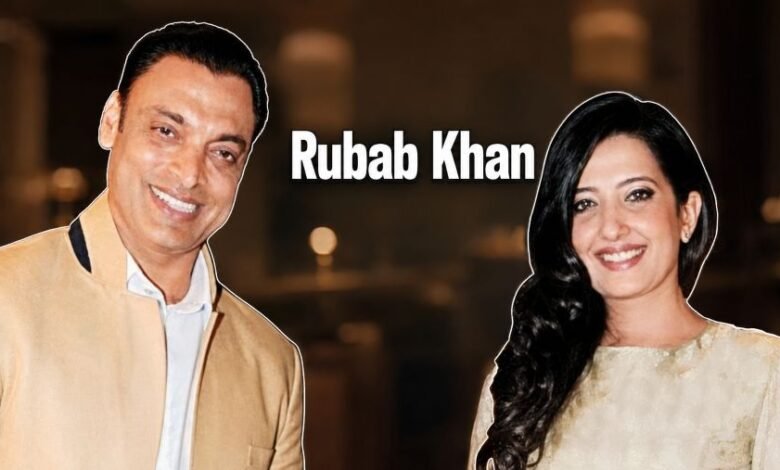
Rubab Khan: Marriage, Children and Life with Shoaib Akhtar
Rubab Khan is known as the wife of former Pakistan fast bowler Shoaib Akhtar and the mother of their three children.

Introduction
Rubab Khan is from Haripur, Pakistan. She became publicly known after marrying Shoaib Akhtar in June 2014. Her husband is one of Pakistan’s most recognised former cricketers and is widely called the “Rawalpindi Express.”
Rubab and Shoaib have two sons, Mikaeel and Mujaddid, and a daughter named Nooreh Ali Akhtar. While Shoaib remains active in cricket commentary and digital media, Rubab has chosen to keep her family life away from regular public attention.
Quick Bio
| Detail | Confirmed information |
|---|---|
| Full name | Rubab Khan |
| Known for | Marriage to Shoaib Akhtar |
| Family origin | Haripur, Pakistan |
| Husband | Shoaib Akhtar |
| Marriage year | 2014 |
| Children | Three |
| Sons | Mikaeel and Mujaddid |
| Daughter | Nooreh Ali Akhtar |
Who Is Rubab Khan?
Rubab Khan is best known as Shoaib Akhtar’s wife. She entered the public eye when news of their marriage appeared in Pakistani media in 2014.
She came from Haripur in Pakistan’s Khyber Pakhtunkhwa province. Her life before marriage remained outside the entertainment and sports industries, which is one reason very little information about her appeared in the media.
Rubab continues to follow a quiet lifestyle. Shoaib has explained that she values privacy, and he respects her decision by limiting the family information and photographs he shares publicly.
How Did Rubab Khan Meet Shoaib Akhtar?
Rubab and Shoaib came together through their families.
Shoaib explained that their families became acquainted during a Hajj journey. His mother spent time with Rubab’s family and later decided that Rubab would be a suitable wife for her son.
Shoaib respected his mother’s judgement and agreed to the match. Their relationship therefore began as a family-arranged marriage rather than a public celebrity romance.
The couple’s story shows the continuing importance of family involvement in many South Asian marriages. Their relationship developed quietly without interviews, public dating appearances or a long media campaign.
Their Private Wedding in Haripur
Rubab Khan and Shoaib Akhtar married in Haripur in June 2014.
The wedding was a small occasion attended by close relatives and friends. The couple did not turn the event into a large public celebration, despite Shoaib’s fame across the cricket world.
Contemporary reports placed the ceremony in late June 2014. The couple continued to follow the same private approach after the wedding.
Shoaib later explained that he limits what he says about his marriage because Rubab prefers to remain outside the public spotlight. His comments about their relationship were reported by Dawn Images.
Who Is Shoaib Akhtar?
Shoaib Akhtar is a former Pakistan international fast bowler, cricket commentator and digital-media personality.
He earned the nickname “Rawalpindi Express” because of his extreme bowling speed. During the 2003 Cricket World Cup, he delivered a ball measured at 161.3 kilometres per hour. It remains the fastest officially recorded delivery in international cricket.
Shoaib represented Pakistan in:
- 46 Test matches
- 163 One-Day Internationals
- 15 Twenty20 Internationals
He retired from international cricket in 2011. After retirement, he remained connected with the sport through analysis, television appearances, interviews and online videos.
His strong public personality is very different from Rubab’s quiet approach. However, the couple appears to have created a balance in which Shoaib continues his public work while protecting his wife’s preference for privacy.
Rubab Khan and Shoaib Akhtar’s Children
Rubab and Shoaib have three children: two sons and one daughter.
Mohammad Mikaeel Ali
The couple welcomed their first son, Mohammad Mikaeel Ali, on 7 November 2016.
Shoaib publicly shared his happiness after becoming a father. He also confirmed that Rubab and their baby were healthy.
Mujaddid
Their second son, Mujaddid, was born in July 2019.
The couple has shared only selected information about their sons. Their children are not regularly used in public or commercial social-media content.
Nooreh Ali Akhtar
Rubab and Shoaib welcomed their third child and first daughter on 1 March 2024.
They named her Nooreh Ali Akhtar. Shoaib announced her arrival by saying that Mikaeel and Mujaddid now had a baby sister. The birth announcement was also covered by Geo News.
The arrival of Nooreh expanded the family to five members.
Why Does Rubab Khan Value Privacy?
Rubab’s limited public presence is a deliberate family choice.
Shoaib has said that his wife has a more private and conservative approach to public life. He therefore avoids sharing too many details about their home, relationship and daily activities.
Her privacy does not mean that there is a hidden story. It means she does not treat her family life as public entertainment.
This approach is also seen among other people connected with famous personalities. Amal Sufiya, the wife of actor Dulquer Salmaan, shares only selected parts of her family life. Television producer Jason Carden also maintains a quieter public profile than his actress wife, D’Arcy Carden.
These examples show that people can be connected with famous partners without turning every personal detail into online content.
Rubab Khan’s Place Among Cricket Families
The spouses of famous cricketers experience public attention in different ways.
Shaniera Akram became known for charity, environmental work and road-safety campaigns after marrying Wasim Akram. Rachel McLellan developed a media role connected with cricket coverage and players’ families.
Rubab followed a different path. She did not build a public identity around regular interviews, campaigns or media appearances. Her story is mainly connected with marriage, motherhood and family privacy.
Neither approach is better than the other. Each person has the right to decide how much of their life they want to share.
A similar need for careful reporting can be seen in profiles such as Meekal Hashmi, whose public information should be separated clearly from unsupported personal claims.
Their Marriage and Family Values
In a 2023 interview, Shoaib spoke warmly about commitment within marriage.
He said that when someone leaves their family home to build a life with a spouse, the other person should respond with kindness, loyalty and strong character. He also said he did not intend to enter another marriage.
His comments provided a rare public look at the values guiding his relationship with Rubab. Rather than sharing private household details, he focused on respect, commitment and responsibility.
These statements help explain why the couple has maintained a stable public image without making their marriage a regular subject of celebrity news.
Why Is Rubab Khan Famous?
Rubab Khan is famous because she is married to Shoaib Akhtar, one of the most recognisable fast bowlers in cricket history.
She is also known as the mother of his three children. However, her public identity is shaped by restraint rather than frequent appearances.
People continue to search for her because they want to understand the family life of the “Rawalpindi Express.” The verified facts present a simple story: the couple met through their families, married privately in 2014 and now have three children.
A Different Kind of Public Presence
Many people assume that the spouse of a famous athlete must become a celebrity. Rubab’s life offers a different example.
She receives public interest without actively seeking attention. Her husband acknowledges her importance while protecting the boundaries she has chosen.
This makes her story relevant in a digital age where personal moments are often shared immediately. Rubab demonstrates that a person can remain important within a famous family without creating a constant public presence.
Frequently Asked Questions
Who is Rubab Khan?
Rubab Khan is the wife of former Pakistan international fast bowler Shoaib Akhtar.
Where is Rubab Khan from?
She is from Haripur in Khyber Pakhtunkhwa, Pakistan.
When did Rubab Khan marry Shoaib Akhtar?
Rubab and Shoaib married in June 2014 in Haripur.
How did Rubab Khan meet Shoaib Akhtar?
Their families became acquainted during Hajj. Shoaib’s mother later proposed the marriage.
How many children do Rubab and Shoaib have?
They have three children: two sons and one daughter.
What are their children’s names?
Their sons are Mohammad Mikaeel Ali and Mujaddid. Their daughter is Nooreh Ali Akhtar.
Why does Rubab Khan avoid public attention?
Shoaib has explained that Rubab values privacy, and he respects her choice by limiting the family details he shares publicly.
Final Thoughts
Rubab Khan became known after marrying Shoaib Akhtar in 2014, but she did not turn that attention into a highly visible public life.
The couple’s relationship began through their families after a Hajj journey. They now have three children named Mikaeel, Mujaddid and Nooreh.
Shoaib remains an outspoken and widely recognised cricket personality, while Rubab protects her personal space. Together, they show that a public career and a private family life can exist side by side when both partners respect each other’s choices.