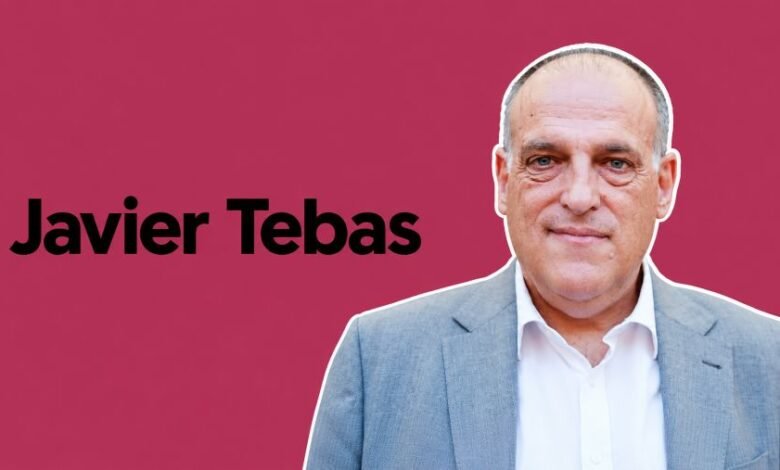
Javier Tebas: Powerful Leadership Shaping Modern LaLiga
Discover how Javier Tebas moved from sports law to the top of Spanish professional football and became one of its most influential and debated leaders.

introdution
Javier Tebas is a Spanish lawyer and football executive best known as the president of LALIGA. Since taking office in 2013, he has played a major role in changing the financial, broadcasting and international strategy of professional football in Spain.
His leadership has produced clear achievements, including stronger financial controls and greater international growth. However, his outspoken personality, strict economic rules and disagreements with major clubs have also made him a controversial figure.
Javier Tebas is the lawyer who became one of the most powerful decision-makers in Spanish football.
Quick Bio
| Field | Information |
|---|---|
| Full Name | Javier Tebas Medrano |
| Also Known As | Javier Tebas |
| Date of Birth | 31 July 1962 |
| Age | 63 years old |
| Birthplace | San José, Costa Rica |
| Nationality | Spanish |
| Profession | Lawyer and football executive |
| Education | Law degree |
| University | University of Zaragoza |
| Current Position | President of LALIGA |
| First Elected | April 2013 |
| Current Term | Fourth consecutive term |
| Famous For | Leading Spain’s professional football league |
| Book | El fútbol no es así |
Who Is Javier Tebas?
Javier Tebas is the president of LALIGA, the organisation responsible for managing Spain’s two leading professional football divisions.
He is responsible for working with clubs on financial rules, television rights, commercial growth, competition planning and the international development of Spanish football.
Unlike a footballer or coach, Tebas built his reputation through law, club administration and sports business management. His decisions can affect player registrations, club spending and the commercial direction of the league.
His position places him at the centre of a football system that includes historic clubs, international stars and developing players from across Spanish football.
Early Life and Costa Rican Birth
Javier Tebas was born on 31 July 1962 in San José, Costa Rica.
Although he was born in Central America, he is Spanish and built his education, legal career and professional life in Spain.
His birthplace creates an interesting connection with Costa Rica, a country with a respected football culture and a strong history of producing international players.
Tebas later developed close professional links with Huesca and Zaragoza, two important locations in the early stages of his legal and football-management career.
Education and Legal Training
Tebas studied law at the University of Zaragoza.
His legal education gave him the foundation needed to understand contracts, company structures, financial disputes and bankruptcy proceedings.
He began practising as a lawyer in 1987. His work gradually became connected with company law, sports law and insolvency cases.
These areas were especially important in Spanish football because several clubs faced serious financial problems, unpaid debts and weak business structures.
According to LALIGA’s official executive profile, his experience in business, sports and bankruptcy law helped shape his later work in professional football.
Legal Business and Professional Partnership
In 1987, Tebas and economist Marta Coiduras Aybar established a legal and accounting practice in Huesca.
The business initially served small and medium-sized companies in the Alto Aragón region. It later expanded its work across legal, employment, tax and accounting services.
Tebas also advised football clubs and sporting organisations dealing with financial or legal difficulties.
This work gave him a detailed understanding of how clubs operated behind the scenes. He learned that sporting success could not remain stable without careful financial management.
First Leadership Role at SD Huesca
Javier Tebas entered football administration directly when he became president of SD Huesca in 1993.
He remained in the role until 1998. During this period, Huesca competed in the lower divisions of Spanish football.
Managing a club at that level gave him experience with limited budgets, operating costs, player payments and the challenges faced by smaller teams.
He later worked in leadership or advisory roles connected with several other Spanish clubs, including CD Badajoz and CD Toledo.
These experiences prepared him for a much larger role within Spain’s professional league organisation.
Rise Through LALIGA
Tebas was elected vice-president of LALIGA in 2001.
In 2003, he became a leading representative of the G-30, a group of clubs that worked together to negotiate audiovisual rights.
The group mainly represented clubs that wanted a stronger position when negotiating television income. Tebas argued that collective organisation could reduce the financial gap between the biggest teams and smaller professional clubs.
This work increased his influence and helped establish him as an experienced football administrator.
Becoming LALIGA President
Javier Tebas was first elected president of LALIGA in April 2013.
His arrival came during a difficult period. Several Spanish clubs were facing heavy debts, unpaid wages and financial instability.
Tebas promised stronger economic controls, improved television-rights management and greater action against match-fixing and illegal broadcasting.
He was re-elected in 2016, 2019 and 2023. His fourth term is scheduled to continue until 2027, according to AP’s report on his re-election.
Financial Control in Spanish Football
Financial control has become one of the defining parts of Tebas’s leadership.
LALIGA reviews club income, spending, debt and expected financial commitments before setting squad-cost limits.
These limits affect how much a club can spend on players, coaching staff and other sporting costs. A wealthy club cannot automatically register every player it signs if it does not meet LALIGA’s financial requirements.
Supporters of the system believe it protects clubs from irresponsible spending and long-term financial failure.
Critics argue that the rules can reduce flexibility and make it more difficult for Spanish clubs to compete with wealthy teams in other European leagues.
Centralised Television Rights
Television rights were previously negotiated separately by individual Spanish clubs.
This system gave the largest teams much greater bargaining power, while smaller clubs received considerably less income.
Tebas supported centralised broadcasting negotiations. Under the newer structure, television income is sold collectively and distributed under an agreed system.
The change helped increase the value of LALIGA’s media rights and created a more balanced financial structure.
Greater income distribution has helped smaller clubs compete, although major teams still earn more because of their performance, audience and commercial importance.
International Growth of LALIGA
Under Tebas, LALIGA increased its activity outside Spain.
The organisation developed international offices, appointed representatives in overseas markets and signed partnerships with football bodies, broadcasters and commercial organisations.
Its goal was to make Spanish club football more accessible to supporters across Asia, Africa, the Americas and other parts of Europe.
This international strategy became increasingly important as domestic leagues competed for global audiences, sponsorship income and broadcast attention.
The wider growth of European football has made international visibility essential for major competitions.
Technology and the Fight Against Piracy
Tebas has strongly promoted the use of technology in football administration.
LALIGA uses data analysis, business intelligence and digital systems to review matches, understand audiences and support commercial decisions.
He has also made the fight against illegal streaming a major part of his public agenda.
Illegal broadcasts reduce the value of official television agreements and affect the income received by clubs.
His approach has included legal action, technical monitoring and cooperation with broadcasters and technology providers.
Relationship With Real Madrid
One of the most discussed parts of Tebas’s presidency is his difficult relationship with Real Madrid and its president, Florentino Pérez.
The disagreements have involved broadcasting rights, financial policies, league governance, the CVC investment agreement and the proposed European Super League.
Tebas has publicly stated that he is a Real Madrid supporter. However, he has repeatedly opposed the club’s leadership when he believes its plans could damage LALIGA or domestic competition.
His conflicts with Real Madrid show that personal support for a club does not always produce agreement at an institutional level.
Opposition to the European Super League
Tebas has been one of the strongest critics of the European Super League project.
He believes that domestic competitions should remain the foundation of professional football.
In his view, clubs should qualify for European tournaments through their results rather than receiving permanent places because of their wealth or historical popularity.
He has also argued that a breakaway league could weaken national competitions, reduce competitive balance and direct too much money towards a small number of clubs.
Supporters of the Super League have challenged that position and argued that European football requires a new commercial structure.
Public Image and Leadership Style
Javier Tebas is known for speaking directly and responding publicly to major football issues.
He frequently discusses club finances, refereeing, racism, piracy, competition formats, broadcasting and football politics.
His supporters view him as a determined leader who was willing to introduce difficult reforms when Spanish clubs needed stronger financial control.
His critics see him as confrontational and believe he becomes too personally involved in disagreements with clubs and football officials.
This contrast has made him one of the most recognisable administrators in world football.
Racism Debate and Public Apology
Tebas faced major criticism in 2023 after responding to Real Madrid player Vinícius Júnior during a public debate about racist abuse.
His initial response was widely viewed as insensitive towards the player’s experience.
Tebas later apologised and explained that he had not intended to attack Vinícius.
He also called for LALIGA to receive stronger legal powers to punish racist behaviour, including the authority to close stadium areas and impose direct sanctions.
The incident became one of the most difficult public moments of his presidency.
Book and Media Work
Javier Tebas co-wrote the novel El fútbol no es así with Pedro Torrens.
The book combines football with a fictional story involving corruption, gambling, power and organised crime.
It later helped inspire the television drama Todo por el juego.
The project allowed Tebas to explore the darker business and legal risks surrounding professional football through fiction.
It also reflected his long-standing interest in integrity, match-fixing and illegal betting.
Personal Life and Football Interests
Tebas is married to Marta Coiduras Aybar, with whom he established his professional legal and accounting business.
He has publicly described himself as a lifelong Real Madrid supporter.
However, his role requires him to represent the wider interests of the professional league rather than one individual club.
His personal interest in football developed alongside his legal work and eventually became the central focus of his career.
Javier Tebas Current Status
As of June 2026, Javier Tebas remains president of LALIGA.
He is serving the fourth consecutive term he secured in 2023. The term is due to run until 2027.
His current leadership continues to focus on club finances, broadcasting income, international expansion, technology, piracy and the future structure of European football.
He also remains involved in debates concerning refereeing reform, artificial intelligence and the possible use of more advanced offside technology.
Impact on Modern LALIGA
Tebas has changed how Spanish professional football is managed as a business.
Financial limits now play a major part in player-registration decisions. Television rights are sold collectively, and international commercial activity has expanded.
His leadership has also increased LALIGA’s role in digital enforcement and the fight against illegal sports streaming.
Players who have competed for a La Liga title have therefore played within a competition shaped by many of the financial and commercial rules developed during his presidency.
Legacy
Javier Tebas’s final legacy will depend partly on what happens before his current term ends.
His supporters are likely to remember him as the leader who improved financial discipline, modernised broadcasting and expanded LALIGA internationally.
His critics will remember the strict spending rules, public arguments and continuing disputes with some of Spain’s largest clubs.
Both views show the scale of his influence. Few football administrators have become as visible or as closely connected with the policies of their competition.
Conclusion
Javier Tebas built his career by combining legal knowledge with football administration.
His journey took him from a law degree and regional legal practice to SD Huesca, LALIGA’s vice-presidency and eventually the presidency of Spanish professional football.
He has introduced major reforms in finance, broadcasting, technology and international growth.
Although his leadership remains controversial, his impact on the modern structure of LALIGA is clear.
Frequently Asked Questions
Who is Javier Tebas?
He is a Spanish lawyer and the president of LALIGA.
What is Javier Tebas’s full name?
His full professional name is Javier Tebas Medrano.
How old is Javier Tebas?
He is 63 years old as of June 2026.
When was Javier Tebas born?
He was born on 31 July 1962.
Where was Javier Tebas born?
He was born in San José, Costa Rica.
What did Javier Tebas study?
He earned a law degree from the University of Zaragoza.
When did Javier Tebas become LALIGA president?
He was first elected in April 2013.
How long will Javier Tebas remain LALIGA president?
His current term is scheduled to continue until 2027.
Which football club does Javier Tebas support?
He has publicly stated that he is a Real Madrid supporter.
Why is Javier Tebas famous?
He is famous for introducing financial controls, centralising television rights and leading LALIGA’s international growth.