Coco Khan: British Journalist, Writer and Podcast Host
From an East London upbringing to becoming a trusted voice in British journalism, culture and political podcasting

Introduction
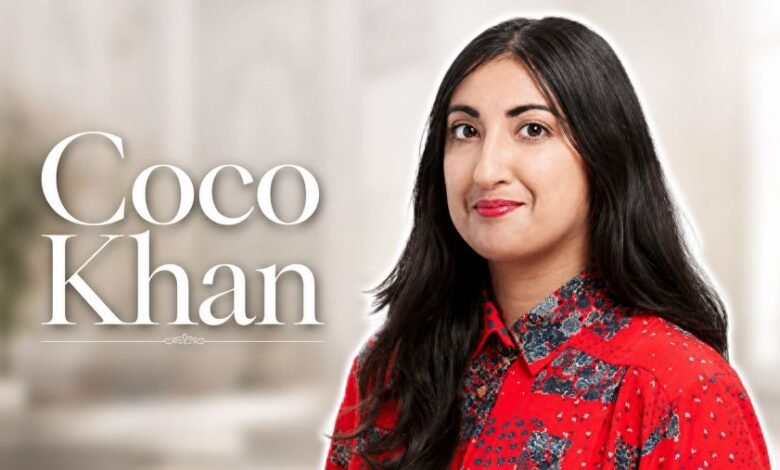
Coco Khan is a British journalist, writer, presenter and podcast host. She is best known for writing features and columns for The Guardian and co-hosting the popular political podcast Pod Save the UK with comedian Nish Kumar.
Born on 29 February 1988 in Barking, East London, Khan grew up in Dagenham and developed an early interest in writing, politics and social issues. Her work now covers British politics, housing, culture, technology, family life, inequality and social mobility.
She has built a respected media career because she can explain serious subjects in a simple, warm and often humorous way. Rather than making complex issues feel distant, she connects them with the everyday lives of ordinary people.
Coco Khan Quick Facts
| Detail | Information |
|---|---|
| Full Name | Coco Khan |
| Date of Birth | 29 February 1988 |
| Age | 38 years old as of July 2026 |
| Birthplace | Barking, East London, England |
| Grew Up In | Dagenham, East London |
| Nationality | British |
| Profession | Journalist, writer, presenter and podcast host |
| Known For | The Guardian and Pod Save the UK |
| University | University of Warwick |
| Degree Subject | English and American Literature |
| Podcast Co-host | Nish Kumar |
| Current Base | London, England |
| Major Book Contribution | The Good Immigrant |
Who Is Coco Khan?
Coco Khan is a freelance British journalist who works across newspapers, books, radio, television, podcasts and live events.
She is especially known for writing about subjects that shape everyday life. These include housing costs, political decisions, social class, diversity, technology, relationships, parenting and popular culture.
Khan does not limit herself to traditional political reporting. She often explores how government policies affect homes, jobs, families and communities.
This human approach separates her from reporters who focus only on political parties and Westminster arguments. Like other modern media professionals, including British journalist and podcaster Carl Anka, she has built a career across several formats rather than working in only one area.
How Old Is Coco Khan?
Coco Khan was born on 29 February 1988. She is 38 years old as of July 2026.
Her birthday is unusual because 29 February normally appears only during a leap year. A person born on this date is sometimes called a “leapling.”
Khan has written humorously about having a leap-day birthday. In a 2019 article, she explained that she celebrates on 1 March when February does not have a 29th day.
Although her official birthday appears only once every four years, her actual age increases normally each year. She will turn 40 on 29 February 2028.
Early Life in East London
Coco Khan was born in Barking and grew up in Dagenham, East London.
She has publicly discussed growing up in social housing in a working-class, single-parent family. These experiences later shaped the subjects she chose to cover as a journalist.
Khan saw how political decisions could quickly affect families with limited financial security. Changes involving housing, public services, education or employment were not distant political debates. They could have an immediate effect on daily life.
She has also spoken about growing up in an area where far-right political activity was visible. This helped her understand how political movements could influence community safety, identity and opportunity.
Her upbringing is an important part of her professional work. It helps explain why she regularly discusses class, social mobility, housing and representation.
Education
Khan attended Mayfield School in Dagenham.
From 2004 to 2006, she studied English Literature, Government and Politics, and Law at A-level. A New City College alumni profile states that she achieved A grades in all three subjects.
She later attended the University of Warwick, where she studied English and American Literature.
Her education combined several subjects that later became useful in journalism. Literature strengthened her writing and storytelling skills, while politics and law helped her understand institutions, government and public debate.
Khan has said that her love of writing developed further during her university years.
Career Beginning
After leaving university, Coco Khan did not immediately enter a major national newspaper.
She began by working in different editorial, marketing and writing positions. One of her early jobs was as an editorial and marketing assistant at Crane.tv, where she created content and helped promote arts and lifestyle stories.
She also worked as a copywriter on projects connected with Amazon, Expedia and eHarmony.
Khan later gained experience as a production and features editor for publications linked with World Travel Market and Arabian Travel Market.
These early positions helped her learn how to write for different audiences. She produced commercial copy, cultural content, travel features and digital media.
She also worked as a television pundit for London Live and as an expert producer for the creative education platform Mastered.
Work at Complex UK
Coco Khan later joined Complex UK, a media platform covering youth culture, entertainment, music, fashion and social issues.
She worked as a senior editor and helped create stories for younger digital audiences.
Her time at Complex strengthened her understanding of internet culture and modern media. It also gave her experience in writing about entertainment while connecting it with wider cultural and social questions.
This ability to move between serious reporting and popular culture later became one of the strongest parts of her public writing style.
Coco Khan and The Guardian
Khan became widely recognised through her work for The Guardian.
She has worked as a columnist, commissioning editor and feature writer. Her articles cover many different subjects, including politics, artificial intelligence, housing, food, social media, parenting, relationships, books and television.
Her writing is often personal, but it normally connects an individual experience with a larger social question.
For example, a light article about fashion or family life may also explore gender expectations, inequality or changing social behaviour.
Readers can find her published features and columns through The Guardian contributor archive.
Her continuing work in 2026 shows that she remains an active freelance journalist and commentator.
Pod Save the UK
Coco Khan is a co-host of Pod Save the UK, a weekly political podcast launched in 2023.
She presents the programme with comedian and political commentator Nish Kumar.
The podcast examines British politics, government policy, elections, social problems and major news events. Politicians, journalists, campaigners, researchers and other public figures regularly join the hosts.
The programme does not simply repeat the week’s headlines. Khan and Kumar try to explain why a political story matters and how it could affect people outside Westminster.
Their conversations use humour, but the show also covers serious subjects such as inequality, public services, housing, discrimination, women’s safety and the cost of living.
Apple Podcasts lists Khan and Kumar as the programme’s hosts and describes it as a weekly show that examines political news and possible solutions.
Her podcast work places her within the wider world of UK political journalism, although her conversational presenting style is different from traditional political reporting.
Why Is Pod Save the UK Popular?
Pod Save the UK has attracted listeners because it makes political discussion easier to follow.
Many political programmes assume that listeners already understand government departments, parliamentary rules and party history. Khan and Kumar often explain the background before discussing the latest development.
Khan also connects national news with ordinary experiences. A discussion about economic policy may include its effect on rent, food prices, childcare or employment.
The podcast mixes information with comedy, making difficult subjects feel less overwhelming.
New episodes continued to be released in 2026, confirming that Khan remained an active host of the programme.
Books and Published Essays
Coco Khan has contributed to several important essay collections.
One of her best-known pieces is “Flags,” which appeared in the 2016 book The Good Immigrant, edited by Nikesh Shukla.
The collection brought together writers discussing race, immigration, identity and life in modern Britain.
Khan’s essay was later adapted for BBC Radio 4’s Book of the Week. She has said that the piece encouraged some readers to reconsider their understanding of identity and racism.
She also contributed to Counterculture UK: A Celebration. Her essay explored ethnicity, authenticity and representation in the arts.
Khan was additionally included in It’s Not About the Burqa, an essay collection featuring writing from Muslim women about culture, faith, identity and feminism. Her appearance in the collection should not be used to make assumptions about private beliefs that she has not personally confirmed.
Her professional agency has also stated that she is working on her first full book.
Broadcasting and Media Appearances
Khan’s career is not limited to writing and podcasting.
Her professional credits include appearances or contributions across BBC radio, television news, discussion programmes and live events.
She has appeared on BBC Radio 4’s The News Quiz, where guests discuss current events through comedy.
She has also contributed to programmes and platforms including BBC Newsnight, Times Radio, BBC Asian Network and London Live.
These appearances show her ability to communicate in different formats. Newspaper writing allows her to develop an argument in detail, while live broadcasting requires clear and fast responses.
Awards and Recognition
Coco Khan has received recognition for her podcasting and broadcasting work.
She received a Best New Voice nomination at the 2023 Audio Production Awards.
Khan and Nish Kumar were also nominated for Best Ensemble Cast for their work on Pod Save the UK.
The podcast appeared on Amazon’s list of notable podcasts of 2023 and won a listener-voted Pod Bible award in the News and Investigation category.
An interview conducted by Khan and Kumar with politician and doctor Rosena Allin-Khan was later shortlisted for news coverage recognition at the 2024 Audio and Radio Industry Awards.
Her professional agency also records her as a winner of Podcast Host of the Year at the UK Audio Network Awards.
Journalism Style
Coco Khan’s journalism style combines humour, curiosity and personal experience.
She often begins with a familiar subject before connecting it to a wider issue. This makes her articles easy to understand without removing the seriousness of the topic.
Her agency describes her approach as one based on humour and humanity. Her interviews normally favour compassion rather than unnecessary conflict.
This does not mean she avoids difficult questions. Instead, she tries to create conversations in which people can explain their experiences and ideas clearly.
Her strongest skill is making complicated subjects feel connected to real life.
Political Views and Public Commentary
Khan openly discusses British politics through her podcast and published work.
She has said that she voted Labour during her adult life, although she does not reduce her complete political identity to one party label.
She has also described herself as a republican in the British constitutional sense. This means she questions whether the monarchy should continue as a political institution.
Her political commentary regularly focuses on power, fairness, wealth, public services and representation.
However, she is a journalist and commentator rather than an elected politician or official party representative.
Husband and Family Life
Coco Khan has publicly referred to being married.
In an August 2025 Guardian column, she mentioned her husband while writing about household lighting preferences. She did not identify him in the article.
In January 2026, Khan wrote about becoming a new mother. She stated that her son was eight months old at the time.
Her comments about parenting have become part of her writing about family life, clothing, work and gender expectations.
Only the family details that Khan has shared herself through her published work should be treated as confirmed.
Public Image
Coco Khan is known as an intelligent but approachable media voice.
Her public work is serious without being difficult to understand. She can discuss government policy in one programme and write humorously about family life, food or internet culture in another.
This range has allowed her to reach people who may not normally follow political journalism.
She also represents a modern type of journalist who works across several platforms instead of depending on one newspaper or broadcasting company.
Her career includes print journalism, editing, books, television, radio, podcasts and public speaking.
Coco Khan’s Impact on Modern Journalism
Khan’s importance comes from the way she connects politics with ordinary life.
She brings working-class and East London experiences into national media discussions. Her writing also adds British Asian perspectives to conversations about culture, identity and opportunity.
Through The Good Immigrant, she contributed to a major public discussion about race and belonging in Britain.
Through Pod Save the UK, she helps listeners understand political stories without making the discussion feel cold or overly technical.
Her journey also shows young writers that there is no single route into journalism. She moved through copywriting, marketing, editing, digital culture, national newspapers and broadcasting before becoming a recognised podcast host.
Conclusion
Coco Khan is a British journalist, writer, presenter and podcast host whose work connects politics, culture and everyday life.
Born in Barking and raised in Dagenham, she developed a strong interest in writing and public issues before studying English and American Literature at the University of Warwick.
Her career grew through editorial work, digital media and cultural journalism. She later became known for her Guardian articles and for co-hosting Pod Save the UK with Nish Kumar.
Khan’s strength is her ability to make difficult subjects understandable. She uses humour without ignoring serious problems and brings human experience into political discussion.
As of July 2026, she remains active as a writer, broadcaster and podcast presenter, with her influence continuing to grow across British media.
Frequently Asked Questions
Who is Coco Khan?
Coco Khan is a British journalist, writer, presenter and podcast host. She is known for writing for The Guardian and co-hosting Pod Save the UK.
What is Coco Khan famous for?
She is famous for her journalism, cultural commentary and political podcasting work.
How old is Coco Khan?
Coco Khan is 38 years old as of July 2026.
When was Coco Khan born?
She was born on 29 February 1988.
Where was Coco Khan born?
She was born in Barking, East London, England.
Where did Coco Khan grow up?
She grew up in Dagenham, East London.
What university did Coco Khan attend?
She attended the University of Warwick and studied English and American Literature.
What podcast does Coco Khan host?
She co-hosts Pod Save the UK.
Who hosts Pod Save the UK with Coco Khan?
British comedian and political commentator Nish Kumar co-hosts the podcast with her.
Does Coco Khan write for The Guardian?
Yes. She is a freelance writer and long-standing contributor to The Guardian.
Is Coco Khan married?
Khan has publicly referred to her husband in her published writing.
Does Coco Khan have children?
Yes. She publicly wrote in January 2026 that she was a new mother to an eight-month-old son.
What books has Coco Khan contributed to?
Her published contributions include The Good Immigrant, Counterculture UK and It’s Not About the Burqa.
Why was Coco Khan born on a rare date?
She was born on 29 February, a date that normally appears only during a leap year.