Saqib Mahmood: England Fast Bowler, Career and Comeback
The clear story of Saqib Mahmood’s age, early life, Lancashire journey, England career, playing style, injuries and return to international cricket

Introduction
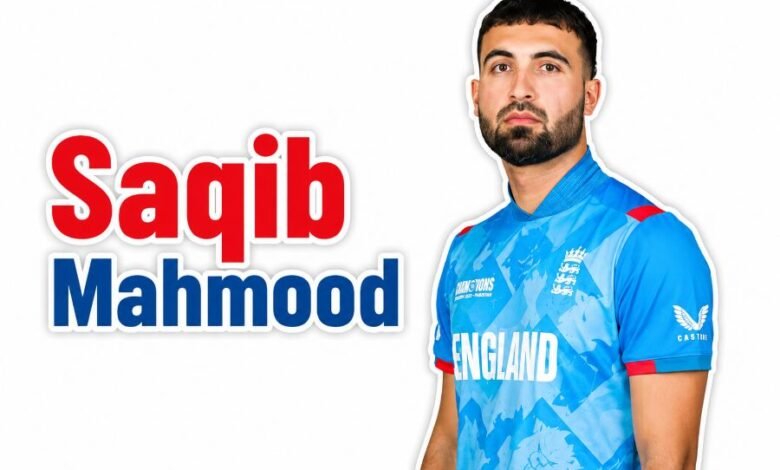
Saqib Mahmood is an English professional cricketer known for his speed, reverse swing and accurate fast bowling.
He plays domestic cricket for Lancashire and has represented England in Test, One Day International and T20 International cricket. He first played for England in 2019 and later became one of the country’s most exciting white-ball fast bowlers.
His career has included strong international performances, major injury problems and an impressive comeback. As of August 2026, he remains an active professional player and is part of England’s white-ball cricket plans.
Quick Facts
| Field | Verified information |
|---|---|
| Full name | Saqib Mahmood |
| Nickname | Saqi |
| Date of birth | 25 February 1997 |
| Age | 29 years old, as of August 2026 |
| Birthplace | Birmingham, England |
| Raised in | Rochdale, Greater Manchester |
| Nationality | English |
| Profession | Professional cricketer |
| Playing role | Fast bowler |
| Batting style | Right-handed |
| Bowling style | Right-arm fast-medium |
| Height | 6 feet 1 inch |
| Main domestic team | Lancashire |
| Shirt number | 25 |
| England debut | 2019 |
| Test debut | 2022 |
| Famous for | Fast bowling, reverse swing and new-ball wickets |
His birth date, height, playing style and Lancashire career are confirmed by his official Lancashire Cricket profile.
Who Is Saqib Mahmood?
Saqib Mahmood is a professional fast bowler who represents Lancashire and England.
He bowls with his right arm and can produce speeds close to 90 miles per hour. His main strengths include attacking the stumps, moving the new ball and finding reverse swing when the ball becomes older.
Mahmood is especially useful during the powerplay and final overs of limited-overs matches. These are difficult periods because batters normally try to score quickly.
He has played international cricket in all three major formats:
- Test cricket
- One Day International cricket
- T20 International cricket
His career has been interrupted by serious back injuries, but he has repeatedly worked his way back into professional and international cricket.
Saqib Mahmood’s Age and Date of Birth
Saqib Mahmood was born on 25 February 1997.
He is 29 years old as of 4 August 2026. He will turn 30 on 25 February 2027.
He was born in Birmingham, England, before moving to North West England during his childhood. He was mainly raised in Rochdale, where he developed his interest and ability in cricket.
Early Life and Cricket Development
Public information about Mahmood’s school education is limited. However, his cricket development is well documented.
He joined Lancashire’s academy and scholarship programme in 2012 when he was around 15 years old.
The academy gave him access to professional coaching, fitness programmes and competitive youth cricket. He represented Lancashire at junior level before moving into the senior team.
In 2014, he was part of the Lancashire Under-17 team that won the Royal London One-Day Cup. The team also shared the two-day Championship title with Surrey.
Mahmood’s performances helped him reach England’s youth system. He represented England Under-19s from the age of 17.
England Under-19 Career
Mahmood gained wider attention during the 2016 ICC Under-19 Cricket World Cup.
He took 13 wickets in six matches and finished as one of the tournament’s leading wicket-takers.
His performances showed that he could succeed against talented young batters from different countries. They also helped establish him as one of England’s most promising fast-bowling prospects.
Before reaching the senior England team, he also trained at an ECB specialist fast-bowling camp in South Africa and represented the England Lions.
The England Lions team is normally used to prepare talented players for senior international cricket.
Lancashire Career
Mahmood signed his first professional contract with Lancashire before the 2015 season.
He made his senior debut during the 2015 T20 Blast and played three matches in the competition. He made his first-class and List A debuts in 2016.
His major domestic breakthrough came in 2019.
During the 2019 One-Day Cup, Mahmood took 28 wickets and finished as the competition’s leading wicket-taker.
His best performances included:
- Six wickets for 37 runs against Northamptonshire
- Five wickets for 14 runs against Leicestershire
- The winning wicket that secured Lancashire’s promotion to County Championship Division One
These performances attracted the attention of England’s selectors and moved him closer to international cricket.
Readers interested in other respected England cricket careers can also explore the story of Marcus Trescothick and his inspiring cricket legacy.
England T20 International Debut
Saqib Mahmood made his T20 International debut against New Zealand on 3 November 2019 in Wellington.
The match marked the beginning of his senior international career.
His early international appearances allowed him to test his bowling against experienced batters. Although his first matches included challenges, England continued to see him as a bowler with speed, control and long-term potential.
England ODI Debut
Mahmood made his One Day International debut against South Africa on 9 February 2020 in Johannesburg.
His biggest early ODI success came during England’s home series against Pakistan in 2021.
England had to select a changed squad shortly before the series, but the new group completed a 3–0 victory.
Mahmood became one of the leading players in the series. He collected nine wickets in three matches and recorded best figures of four wickets for 42 runs.
He was named Player of the Series for his bowling performances.
This series became a major turning point in his England career. It showed that he could lead a pace attack and take important wickets with the new and old ball.
Test Debut
Mahmood made his Test debut against the West Indies in Barbados on 16 March 2022.
He played two Tests during England’s tour of the Caribbean.
Test cricket places greater physical pressure on a fast bowler because the player may need to bowl many overs across several days. Mahmood performed well and demonstrated that his skills could work outside limited-overs cricket.
He took six wickets during the two-Test tour and also showed useful ability as a lower-order batter.
His highest Test score is 49.
Playing Style
Saqib Mahmood is a right-arm fast-medium bowler.
He is known for combining speed with movement. Instead of depending only on pace, he tries to make the ball move through the air or after it reaches the pitch.
His main bowling qualities include:
New-ball bowling
Mahmood can attack during the opening overs when the ball is hard and may move through the air.
Reverse swing
He can move an older ball in the opposite direction from normal swing. This skill can make him dangerous during the middle and final parts of an innings.
Yorker deliveries
A yorker lands close to the batter’s feet. It is difficult to hit and can also strike the stumps.
Powerplay wickets
Mahmood has developed a reputation for taking wickets during the first six overs of T20 matches.
Death-over bowling
He can bowl under pressure near the end of an innings when batters are trying to score boundaries.
His mixture of pace, swing and accuracy has made him useful in different match situations.
Serious Back Injuries
Mahmood’s progress was stopped by a lumbar stress fracture in 2022.
The injury was discovered only a few months after his Test debut. It ruled him out for the rest of the 2022 English cricket season.
A stress fracture is a small crack in a bone caused by repeated physical pressure. Fast bowlers can be at greater risk because their actions place heavy force on the lower back.
Mahmood worked with Lancashire and England’s medical teams during his recovery.
However, he suffered another problem with the same area during the 2023 season. The setback forced him to spend another long period away from competitive cricket.
These injuries became the biggest challenge of his professional career.
Return to Cricket
Mahmood gradually returned to competitive cricket after completing a carefully managed rehabilitation programme.
Lancashire controlled his bowling workload to lower the risk of another injury. He mainly focused on shorter formats because T20 cricket normally requires only four overs from each bowler.
His strong return in 2024 helped him regain attention from England’s selectors.
Lancashire later gave him a three-year white-ball contract running until the end of the 2027 season. The agreement also includes an option for him to play red-ball cricket when his fitness, availability and selection allow it.
The Hundred Final Performance
One of Mahmood’s greatest comeback moments arrived in The Hundred final in August 2024.
Playing for Oval Invincibles against Southern Brave, he took three wickets for only 17 runs.
He dismissed Leus du Plooy, Kieron Pollard and Laurie Evans in a damaging seven-ball period.
His spell changed the match and helped Oval Invincibles win the men’s competition for a second consecutive year.
Mahmood received the Player of the Match award for his performance in the final.
The display was especially important because it came after two injury-affected seasons.
Return to the England Team
Mahmood returned to England’s white-ball team after proving his fitness.
During England’s T20I series in the West Indies in November 2024, he took nine wickets and caused major problems during the powerplay.
He was named Player of the Series as England won the series 3–1.
His performances showed that he had regained his speed, control and confidence.
England later awarded Mahmood his first full central contract for the 2025–26 period. His one-year agreement runs until 30 September 2026.
He also returned to England’s T20I and ODI squads during the 2026 home series against India. The ICC player database lists his most recent international appearance in 2026.
Current Team and Contract
As of August 2026, Mahmood remains connected with Lancashire and the England cricket system.
His Lancashire white-ball contract is scheduled to continue until the end of the 2027 season.
He was also included in England Lions squads during 2026 before returning to England’s senior white-ball group.
The Lions appearances allowed him to gain match practice and show selectors that he remained ready for international cricket.
Domestic and Franchise Teams
During his professional career, Mahmood has represented teams including:
- Lancashire
- England Under-19s
- England Lions
- England
- Peshawar Zalmi
- Oval Invincibles
- Sydney Thunder
Franchise teams and competition names may change between seasons, so they should not always be treated as permanent clubs.
For another international cricket profile, read about Ibrahim Zadran’s powerful rise in Afghan cricket.
Saqib Mahmood’s Height
Saqib Mahmood is listed as 6 feet 1 inch tall.
His height gives him a useful release point when bowling. A higher release can help a fast bowler create bounce from the pitch.
However, his success comes from more than height. His speed, swing, accuracy and ability to study batters are equally important.
Personal Life
Mahmood keeps much of his personal life private.
There is no reliable public confirmation about a wife, partner or children in the official sources reviewed for this article.
Unverified relationship claims should not be treated as facts.
Mahmood has publicly discussed observing Ramadan while working as a professional athlete. He has explained that managing food, water, training and recovery requires careful planning.
He has also taken part in community Iftar events and spoken about the responsibility professional sportspeople have to support younger people and their local communities.
Family Background
Mahmood was born in England and raised in Rochdale.
Reliable cricket sources have reported that his family has Pakistani roots. However, detailed information about his parents and siblings has not been widely confirmed through official public sources.
For this reason, names and private family details should not be added without clear verification.
Is Saqib Mahmood Married?
There is no publicly confirmed information showing that Saqib Mahmood is married as of August 2026.
He does not regularly discuss romantic relationships in official cricket interviews.
Articles or social-media posts claiming to identify his wife or girlfriend should be treated carefully unless Mahmood or a reliable official source confirms the information.
Saqib Mahmood’s Net Worth
No reliable official source has confirmed Saqib Mahmood’s exact net worth.
He earns income through professional cricket, which may include Lancashire contracts, England agreements and franchise competition payments.
However, exact salary and wealth figures published by unofficial websites are normally estimates. They should not be presented as verified facts.
Major Career Achievements
Mahmood’s important achievements include:
- Representing England Under-19s
- Taking 13 wickets at the 2016 Under-19 World Cup
- Leading the 2019 One-Day Cup wicket table with 28 wickets
- Making his England T20I debut in 2019
- Making his England ODI debut in 2020
- Winning the 2021 ODI Player of the Series award against Pakistan
- Making his Test debut in 2022
- Returning after two serious back injuries
- Winning Player of the Match in the 2024 Hundred final
- Winning the 2024 T20I Player of the Series award in the West Indies
- Receiving his first full England central contract in 2025
- Returning to England’s white-ball squads in 2026
Interesting Facts About Saqib Mahmood
- He joined Lancashire’s academy in 2012.
- He made his Lancashire senior debut in 2015.
- He played for England Under-19s from the age of 17.
- He took 28 wickets in the 2019 One-Day Cup.
- His nickname is Saqi.
- His playing number for Lancashire is 25.
- He can bowl at speeds close to 90 miles per hour.
- He was the final bowler to dismiss Kumar Sangakkara in first-class cricket.
- He scored 49 in a Test innings despite being selected mainly as a bowler.
- He returned to international cricket after two major back-injury setbacks.
Why Is Saqib Mahmood Famous?
Saqib Mahmood is famous for playing international cricket for England and county cricket for Lancashire.
He became widely known after leading the wicket table in the 2019 One-Day Cup and producing a Player of the Series performance against Pakistan in 2021.
His comeback from repeated back stress fractures also became an important part of his story.
The Player of the Match performance in the 2024 Hundred final proved that he could still deliver under pressure after spending long periods away from cricket.
Frequently Asked Questions
Who is Saqib Mahmood?
Saqib Mahmood is an English professional fast bowler who plays for Lancashire and has represented England in Test, ODI and T20I cricket.
How old is Saqib Mahmood?
He is 29 years old as of August 2026.
When was Saqib Mahmood born?
He was born on 25 February 1997.
Where was Saqib Mahmood born?
He was born in Birmingham, England, and was raised mainly in Rochdale.
How tall is Saqib Mahmood?
He is listed as 6 feet 1 inch tall.
What is Saqib Mahmood’s bowling style?
He bowls right-arm fast-medium.
Which county does Saqib Mahmood play for?
He plays white-ball cricket for Lancashire.
When did Saqib Mahmood make his England debut?
He made his T20 International debut against New Zealand on 3 November 2019.
When did he make his Test debut?
He made his Test debut against the West Indies on 16 March 2022.
Is Saqib Mahmood married?
There is no reliable public confirmation that he is married as of August 2026.
What is Saqib Mahmood’s net worth?
His exact net worth has not been confirmed by a reliable official source.
What injuries has Saqib Mahmood suffered?
He suffered serious back stress fractures that affected his 2022 and 2023 seasons.
Does Saqib Mahmood still play for England?
He returned to England’s senior white-ball squads in 2026 and remained centrally contracted through 30 September 2026.
Conclusion
Saqib Mahmood has built his cricket career through natural speed, accurate bowling and determination.
He progressed from Lancashire’s academy to England Under-19 cricket before making his senior international debut in 2019. His performances against Pakistan in 2021 showed that he could lead England’s fast-bowling attack.
Two serious back injuries then placed his career at risk. However, he completed a long rehabilitation process and returned with an outstanding performance in the 2024 Hundred final.
His return to England’s white-ball setup and first full central contract demonstrated the value of his comeback.
As of August 2026, Mahmood remains an active fast bowler with Lancashire and continues to compete for opportunities in the England team.