Donal MacIntyre: Career, Undercover Journalism and Current Work
The Irish investigative journalist who became known for undercover reporting, crime documentaries and criminology work.

Introduction
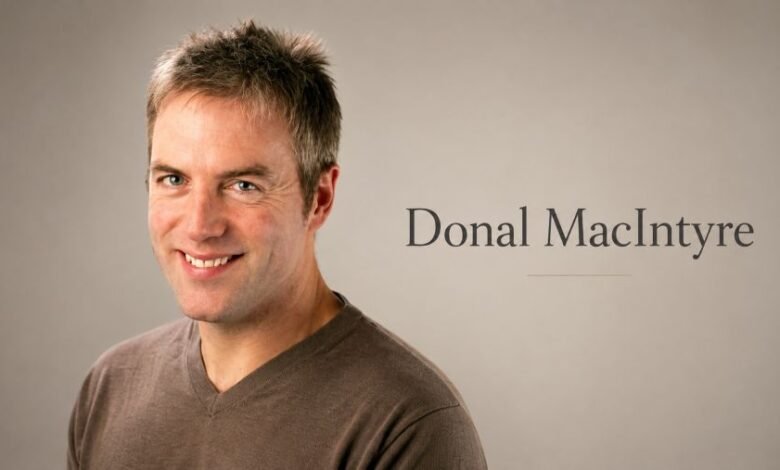
Donal MacIntyre is an Irish investigative journalist, television presenter, documentary maker and criminologist. He became widely known for entering difficult and sometimes dangerous environments to investigate crime, abuse, football violence and other serious issues.
His career has covered television, radio, documentary filmmaking and academic criminology. Some viewers may remember him from MacIntyre Undercover, while newer audiences may know him from programmes such as Donal MacIntyre’s UK Killer Evidence.
As of August 2026, he remains professionally active. He is listed as a Visiting Professor with Birmingham City University’s Centre for Applied Criminology and continues to appear in true-crime television productions.
His long career makes him an important figure in British and Irish investigative broadcasting, particularly for readers interested in UK entertainment and television personalities.
Quick Facts
| Fact | Details |
|---|---|
| Full name | Donal MacIntyre |
| Birthplace | Dublin, Ireland |
| Profession | Investigative journalist, presenter, documentary maker and criminologist |
| Education | Politics and Economics at University College Dublin |
| Postgraduate study | Communications Policy at City University London |
| Known for | Undercover investigations and crime documentaries |
| Major programme | MacIntyre Undercover |
| Film work | Directed A Very British Gangster |
| Academic role | Visiting Professor at Birmingham City University |
| Current television work | Donal MacIntyre’s UK Killer Evidence |
| 2026 project | Noah Donohoe: The Search for Truth |
Who Is Donal MacIntyre?
Donal MacIntyre is best known for investigative journalism that places the reporter close to the subject being examined.
Instead of only interviewing people after an event, his earlier work often involved entering environments connected with crime, violence or abuse. This style helped make him a recognised television journalist during the 1990s and early 2000s.
He worked across major British broadcasting outlets, including ITV and the BBC, and later developed a strong presence in true-crime programming.
His professional work has also moved beyond television. He has been involved in criminology research and university teaching, giving him a career that connects journalism with the academic study of crime.
Early Life and Education
MacIntyre was born in Dublin, Ireland.
He studied Politics and Economics at University College Dublin. His education gave him a background in public affairs, economics and political systems before he entered professional journalism.
He later completed postgraduate study in Communications Policy at City University London.
These areas of study were closely connected to the career he eventually built. His later reporting regularly examined institutions, organised crime, social problems and the way powerful groups operate.
How His Journalism Career Started
MacIntyre began working as a newspaper reporter before moving into television.
During the late 1980s and early 1990s, he worked in Irish journalism, including reporting connected with the Sunday Tribune.
Television later became the main platform for his investigative work.
One important early stage of his career was his involvement with ITV’s World in Action. The programme had a strong reputation for serious investigative reporting and gave journalists opportunities to examine subjects that were difficult to cover through ordinary interviews.
This period helped MacIntyre develop the undercover approach that would later define much of his public career.
MacIntyre Undercover and His Breakthrough
One of the biggest turning points came with the BBC programme MacIntyre Undercover.
The series became known for investigations in which he entered organisations or groups while hiding his real purpose.
The subjects were often serious and risky.
His investigations covered areas such as football hooliganism, the modelling industry and conditions inside residential care facilities.
The programme became strongly associated with the idea of immersive reporting. Viewers were not simply being told what happened. They could see how events unfolded from inside the environment being examined.
That approach made his work memorable, but it also brought significant personal risk.
The Chelsea Football Hooligan Investigation
One of MacIntyre’s most widely remembered investigations involved football hooliganism.
He infiltrated people connected with the Chelsea Headhunters, a group associated with football violence.
The work required him to spend time around individuals while keeping his identity and journalistic purpose hidden.
Years later, the investigation continued to be mentioned as one of the defining examples of his undercover reporting.
The case also demonstrated how different his working method was from standard studio-based television journalism. His reporting often depended on access, observation and personal exposure to risky situations.
Investigation Into Residential Care
Another important investigation examined conditions inside a residential care setting.
The programme raised concerns about the treatment of residents and became one of the pieces of work MacIntyre later discussed as particularly important.
The care home featured in the investigation subsequently closed.
This example shows that his reporting was not limited to criminal gangs. His work also focused on vulnerable people, institutions and situations where individuals might have limited ability to speak publicly for themselves.
A Very British Gangster
MacIntyre later moved into documentary filmmaking.
He directed A Very British Gangster, a documentary centred on Manchester criminal Dominic Noonan and the people around him.
The film represented a different style from his earlier undercover investigations.
Rather than secretly entering a group, the documentary was based on direct access.
A Very British Gangster appeared in the 2007 Sundance Film Festival programme, giving the project an international platform.
The documentary became one of the best-known feature-length works connected with his career.
Work in Radio and Television News
His broadcasting career has not been limited to undercover investigations.
MacIntyre also worked in radio, including presenting investigative programming for BBC Radio 5 Live.
In 2010, he joined ITV’s London Tonight in a presenting role.
This was different from the work for which he was best known. Instead of spending long periods developing covert investigations, he was appearing in a more traditional television news environment.
His regular role on the programme was relatively short, and he later returned his attention to documentary projects, directing and other media work.
Move Into Criminology
One of the more unusual parts of MacIntyre’s career is his move from crime reporting into academic criminology.
He became connected with Birmingham City University’s Centre for Applied Criminology.
As of August 2026, the university lists him as a Visiting Professor.
His work there has included involvement in criminology research.
He was among the contributors to academic research examining contract killers in Britain. The study looked at patterns in contract killings and attempted to classify different types of people involved in such crimes.
This academic connection gives his career an additional dimension.
He does not only present crime stories for television audiences. He has also participated in formal research examining how criminal behaviour can be studied and understood.
Donal MacIntyre and True-Crime Television
In more recent years, true-crime television has become a major part of his public work.
He has presented several crime-focused series examining murder investigations, criminal evidence and convicted offenders.
Programmes connected with his later career include:
- Donal MacIntyre’s Click For Murder
- Donal MacIntyre: Murder Files
- Donal MacIntyre’s Released to Kill
- Donal MacIntyre’s Killer Evidence
- Donal MacIntyre’s UK Killer Evidence
These programmes usually examine how police, forensic specialists and investigators build cases.
The format is different from the undercover work that first made him famous, but the central subject remains similar: understanding serious crime and how investigators uncover the truth.
Donal MacIntyre’s UK Killer Evidence
Donal MacIntyre’s UK Killer Evidence is one of his most recent television projects.
The series looks at British murder cases and focuses on the evidence that helped investigators identify offenders.
The programme uses case material, expert analysis and investigative details to explain how different pieces of evidence can become important in a criminal case.
Season 3 began airing in 2026.
The programme also remains available through television and streaming services, introducing his work to viewers who may not remember his earlier BBC investigations.
A Life in Crime
A documentary titled Donal MacIntyre: A Life in Crime examined his long professional career.
The production looked back at decades of investigative work, including his experience going undercover.
According to the production company behind the programme, he has undertaken undercover operations more than 50 times during his career.
That figure helps explain why undercover reporting became so closely linked with his professional name.
Very few television journalists have built such a large part of their public career around repeatedly entering risky environments under concealed identities.
Noah Donohoe Investigation
MacIntyre has also been involved in examining the death of Belfast teenager Noah Donohoe.
Noah died in 2020, and the case became the subject of major public attention in Northern Ireland.
MacIntyre carried out investigative work connected with the case and later supplied material to the inquest process.
Court reporting in 2025 confirmed that information he provided had been received and that his assistance was acknowledged during the proceedings.
This work has continued into another major project.
Noah Donohoe: The Search for Truth
A book titled Noah Donohoe: The Search for Truth is scheduled for publication on 24 September 2026.
The book is connected to MacIntyre’s investigation of the case and is expected to examine available documents, statements and evidence surrounding Noah’s death.
Because the publication date is after August 2026, the book should currently be described as forthcoming rather than already released.
It shows that his investigative career is continuing through publishing as well as television.
Public Controversy and the Elite Case
A profile of MacIntyre’s career should also include an important dispute connected with one of his earlier BBC investigations.
His 1999 programme examining the modelling industry led to legal action involving Elite Model Corporation.
In 2001, the BBC and MacIntyre were involved in the settlement of a High Court libel case brought by Elite.
The BBC acknowledged that aspects of the programme had unfairly represented the agency.
The financial or detailed settlement terms were not publicly released.
The issue is important because it remains one of the most significant editorial controversies associated with his television career.
It should be described as a media and libel dispute rather than a criminal matter.
Why His Career Stands Out
MacIntyre’s career is unusual because it combines several different professional areas.
He first became famous through dangerous undercover investigations.
He later directed documentaries, presented radio programmes, worked in television news and developed a long-running connection with true-crime broadcasting.
He also moved into university criminology.
That combination of field journalism, television storytelling and academic crime research gives him a different profile from many traditional television presenters.
Is Donal MacIntyre Still Working?
Yes.
As of August 2026, Donal MacIntyre remains active professionally.
He continues to be connected with Birmingham City University as a Visiting Professor.
His crime television programmes remain in circulation, and new episodes of UK Killer Evidence aired during 2026.
His forthcoming Noah Donohoe book also shows that he continues to work on investigative projects.
He is therefore not simply remembered as a former BBC undercover reporter. His present career still includes television, criminology and investigative publishing.
Final Overview
Donal MacIntyre built his reputation by taking investigative journalism into places that ordinary reporting rarely reached.
His undercover work for programmes such as World in Action and MacIntyre Undercover made him widely recognised, while later projects expanded his career into documentary filmmaking, true-crime television and academic criminology.
Today, he remains connected to both broadcasting and crime research.
For viewers who remember his undercover investigations, his career shows how television journalism changed over several decades. For newer audiences, his true-crime programmes and current investigative projects continue to introduce his work to another generation.